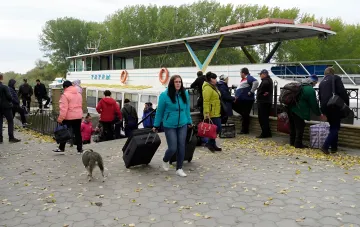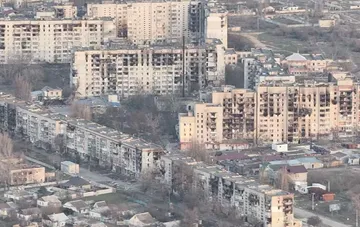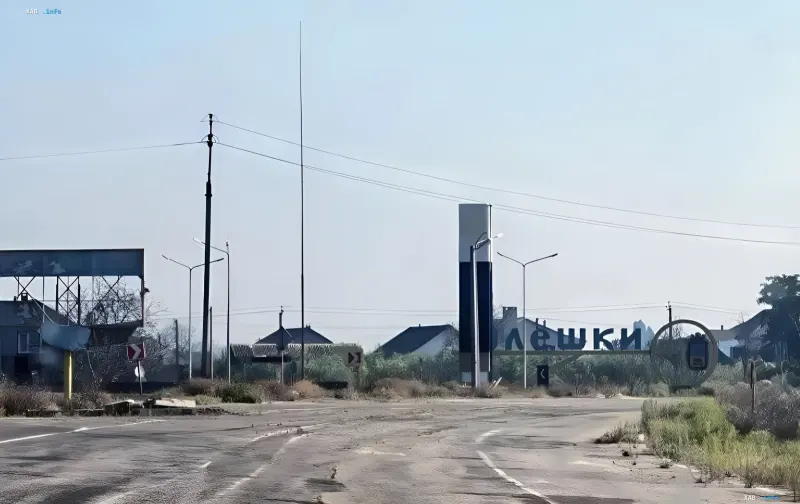
In the temporarily occupied part of the Kherson region, near the town of Oleshky, a ceasefire has been introduced, during which the procedure for the departure of local residents is being discussed. According to information provided by the Financial Times, people who have agreed to leave the occupied territory during the ceasefire will not be taken directly to the Ukrainian-controlled side. They will first be taken to the Russian Federation or occupied Crimea, and only after that will they be given the opportunity to move to territory controlled by Kyiv.
Evacuation route: Russia or Crimea first
According to FT data, the logistics of the departure are structured in such a way that the transit point for the evacuated residents of Oleshky becomes either the territory of Russia or the occupied peninsula. Only after arriving at one of these points will people be able to continue their journey to Ukrainian-controlled territory. According to the Ukrainian authorities, this procedure creates additional risks and restrictions for the residents themselves, as their movement becomes dependent on the decisions of the occupying structures at the intermediate stage.
Kyiv's position: risk of "illusion of voluntary choice"
President Volodymyr Zelenskyy previously noted that the Russian side would do everything possible to organize the mining of the territory in a way that directs people towards Russia. The head of state declared that the occupiers intend to use the evacuation process itself for their own purposes, in particular to create an illusion for the international community that thousands of Ukrainian citizens are allegedly voluntarily choosing to leave for the aggressor country. Thus, Kyiv interprets the proposed route as a tool for political pressure and information manipulation.
Ceasefire in southern Ukraine
As stated by the head of the "Servant of the People" faction, David Arakhamia, a ceasefire began in southern Ukraine at 3:00 Kyiv time, which will last until November 1. It is during this period, according to reports, that the organization of the departure of Oleshky residents is planned. The ceasefire creates a temporary window for the movement of citizens, however, as Ukrainian sources emphasize, the conditions of this movement remain a subject of dispute between the parties.
Moscow's reaction and international context
Against the backdrop of the discussion on the ceasefire in Oleshky, the spokesman for the Russian leader Dmitry Peskov announced the possibility of extending the First Lady of the United States' peacekeeping initiatives to other combat zones. This statement fits into a broader diplomatic context in which both sides publicly present their actions as aimed at de-escalation, while the specific mechanisms of evacuation and control over routes remain under the authority of the occupying structures.
What this means for the residents of Oleshky
For the residents of the temporarily occupied Oleshky themselves, the proposed procedure means that their departure from the conflict zone is not a direct and one-time transfer to Ukrainian-controlled territory. The intermediate stage in the RF or occupied Crimea, according to Kyiv, could be used to record a "voluntary" choice and to manage the flow of citizens. More details on the parameters of the ceasefire in Oleshky and the conditions for the residents' departure can be found in the RBC-Ukraine report.