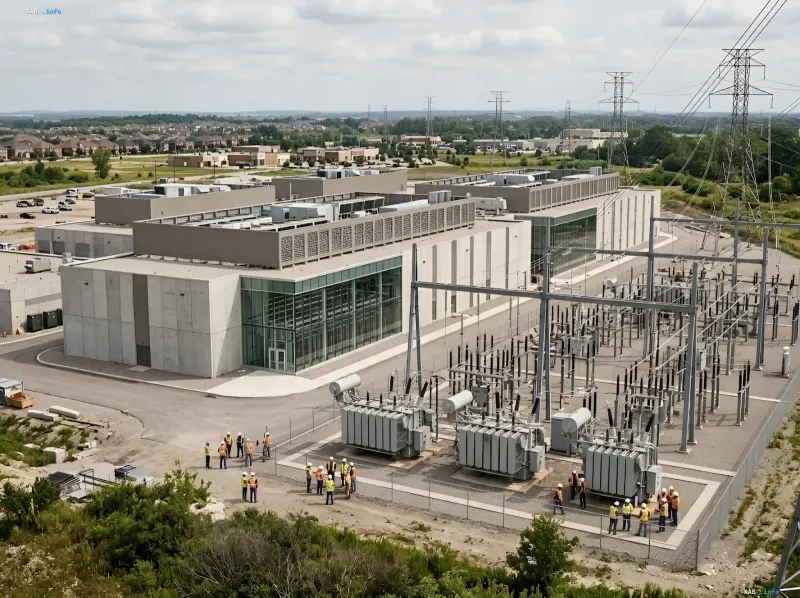
On August 13, 2026, the authorities of the Canadian province of Ontario officially launched a 30-day public consultation period on new regulations governing the connection of large data centers to the power grid. This decision is a direct response to the surging demand for computing power driven by the boom in artificial intelligence and cloud technologies. The proposed framework establishes a separate tariff class for new facilities exceeding 1 MW in capacity and introduces mandatory government approval for their connection or reconnection to the electrical grid. The consultation period will run until September 12.
The "User Pays" Principle: Ending AI Subsidies
The core principle of the proposed reform is that new data centers must fully cover the costs associated with their power supply, without shifting the financial burden onto existing consumers. Ontario Premier Doug Ford has clearly stated the government's position: the province does not intend to provide free electricity or infrastructure to new data centers. Authorities are also considering strict requirements for paying for necessary grid upgrades, meaning that the costs of modernizing substations and transmission lines will fall on the shoulders of tech giants rather than taxpayers.
Comprehensive Assessment: From Economics to Ecology
Under the new system, projects will be evaluated not only on their technical ability to connect to the grid. The proposed model includes three main assessment areas: contribution to economic development, ensuring digital sovereignty, and benefits to local communities. Special attention is paid to environmental requirements, including water consumption and noise levels. This is critical for large data centers, where high-density computing equipment places a colossal load on the power grid and requires powerful, often noisy and water-intensive cooling systems.
Conflicting Data: Municipalities Fight for Veto Power
The Ontario government's proposal has sparked sharp debates at the local level. While the province aims for centralized regulation, municipalities have expressed serious concern. The city of Oakville has already imposed a one-year moratorium on data center construction, and Mississauga authorities are considering a similar measure. Residents and local officials point to noise, massive water consumption, heat emissions, air pollution, and strain on local infrastructure. However, according to the current draft of the proposed system, municipalities will not receive veto power over such projects, creating a conflict between federal interests in AI development and local environmental issues.
Uncertainty of Details and the Future of the Industry
At present, the final power thresholds, connection criteria, cost allocation rules, and exact implementation timelines have not yet been determined. For now, Ontario is proposing a model where the expansion of AI infrastructure is viewed not just as a matter of site availability and graphics accelerators (GPUs), but as a separate, heavy load on the energy system. The cost of this load must be accounted for by new projects during the planning and connection stages, which could significantly alter the economics of building data centers in the region.