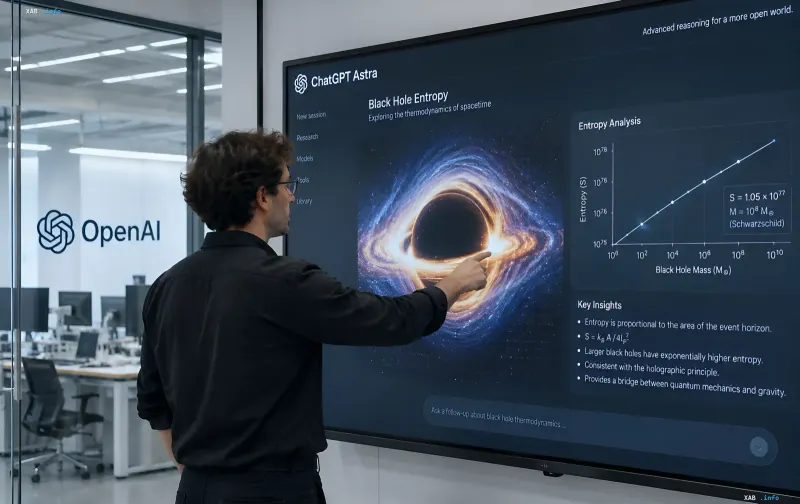
OpenAI physicist Venkatesh Chandrasekaran has published a study on the preprint server Alphaxiv proposing a new mathematical method for describing gravity in empty four-dimensional spacetime. The core idea of the work is not to treat spacetime as a fixed background, but to derive gravitational laws from a quantum description where geometry itself emerges as a consequence. According to RBC-Ukraine, this approach makes it possible to reproduce the fundamental formulas of Einstein's theory and show how quantum effects can modify gravity at the smallest scales.
From Causal Diamond to Quantum Integral
The researcher examines how light moves at the boundary of a special region of spacetime that physicists call a causal diamond — a region within which events are connected by causal relationships. Using mathematical methods, Chandrasekaran translates this description into a quantum form, uniting the rules of quantum mechanics with gravity. As a result, gravity is described via a path integral, a method that accounts for all possible pathways of a quantum system's evolution, bypassing a fixed classical background.
Reproduced Formulas and Agreement with Ashoke Sen's Result
Within the framework of the new approach, the author successfully reproduced the Bekenstein–Hawking formula, according to which black hole entropy is proportional to the area of its event horizon — the boundary beyond which even light cannot escape the object. In addition, an additional logarithmic correction for large Schwarzschild black holes was calculated; the obtained coefficient matches the result that physicist Ashoke Sen previously derived using an independent authorial method. Einstein's equations in the low-energy limit and the first quantum correction to them were also reproduced.
The Role of GPT-6 Astra: About 400 Million Tokens
The work was carried out over several months in close interaction with the GPT-6 Astra model, which reportedly consumed about 400 million tokens. The AI helped perform mathematical calculations and work on proofs in the highly specialized field of theoretical physics. OpenAI CEO Sam Altman spoke positively about the work, noting that Chandrasekaran had believed from the early stages in the models' ability to solve complex mathematical problems, including Millennium Prize Problems. At the same time, independent tests evaluate the capabilities of GPT-6 Astra more reservedly: according to 3DNews, in one benchmark the model proved to be barely better than its predecessor, while the company itself positions it as a "revolutionary system".
Limitations and Preprint Status
Despite the results obtained, the model describes gravity only in a vacuum — without matter — and therefore does not provide a complete description of gravity in the Universe. Researchers have yet to determine whether this approach predicts measurable phenomena that would distinguish the method from other theories. It is noted that the work is published as a preprint and must still undergo independent review by the scientific community before its conclusions can be considered established.