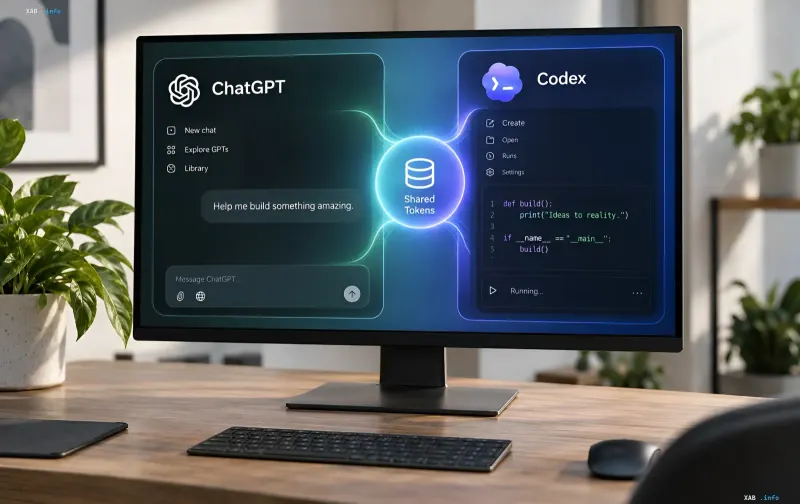
Starting December 2026, OpenAI is introducing a fundamentally new resource tracking system within the ChatGPT ecosystem. Subscribers to Plus, Pro, and Business tiers will receive a unified token usage allowance distributed between the regular chat and the developer tool Codex. This is reported in the company's updated Help Center materials. The change is directly tied to integrating Work module functionality directly into the core ChatGPT interface, making unified resource tracking a logical consequence of the product's architectural redesign.
How the Single Token Pool Will Work
From now on, service consumption is measured in tokens—the basic units of text that the model processes and generates during operation. The exact number of consumed tokens depends on two factors: the model chosen by the user and the complexity of the task. In practice, this means prolonged coding work in Codex will reduce the available limit for complex queries in the chat, and vice versa. Previously, Chat, Work, and Codex functioned as separate products with independent restrictions, including separate quotas for uploading images, files, and voice messages. Now, all these interactions are combined into a single resource "pool" from which every type of query draws.
What Remains Unlimited: Instant Mode
An important exception to the new system will be the Instant chat mode. Its use will not affect the total token limit, allowing users to continue asking simple everyday questions without expending their main resource reserve. Essentially, OpenAI is preserving an "unlimited" layer for basic interaction, shifting paid accounting to advanced scenarios: working with long context, code generation, document analysis, and utilizing heavy models. After the December update, users can check their remaining limit and reset time in the ChatGPT settings under the Usage section.
What the Company Has Not Disclosed Yet
Despite the announcement, OpenAI has not disclosed several key details: what the exact total limit will be for each of the Plus, Pro, and Business subscription tiers, how often it will refresh (daily, weekly, or by subscription cycle), and what conditions will apply to Free and Go users. When the resource reserve is exhausted, users will either have to wait for it to replenish, upgrade to a more expensive tier, or purchase additional credits. This uncertainty has become a major topic of discussion in the community: on the OpenAI forum, a thread urging the company to keep the previous separate limits gathered over 100 posts from dissatisfied users.
Context: The End of the Unlimited Query Era
AI product experts view OpenAI's move as the factual end of the unlimited query era characteristic of the early period of mass adoption for generative models. Notably, Anthropic has already implemented a similar resource accounting model for its Claude models, making the shift to a token economy an industry trend rather than an isolated decision. Additional context is provided by OpenAI's recent admission: after merging the ChatGPT and Codex desktop applications, the company acknowledged that the interface had become too complex for users and announced plans to simplify it. The unified token pool is presumably part of this same product consolidation strategy.
Practical Recommendations for Users
For those who regularly work with Codex or advanced models, analysts advise tracking consumption statistics in the Usage section during the first few days after the December update before purchasing additional credits. This will help build an understanding of how a specific workflow consumes tokens. For everyday tasks—quick questions, short answers, simple phrasing—it is recommended to consciously use Instant mode so as not to deplete the general limit. Thus, OpenAI is essentially inviting users to consciously manage their computational resource "budget," marking a significant shift from the previous "ask and receive" paradigm.