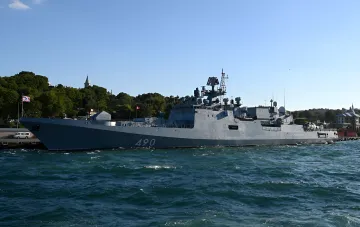
Ukrainian cyber specialists have reported the completion of a large-scale operation under the codename "Poseidon," during which, they claim, Russia's scientific and industrial base for naval purposes was fully compromised. This was reported on September 21, 2026, by RBC-Ukraine, citing the Ukrainian Militant Telegram channel. According to the hackers, the targets included leading Russian scientific organizations, design bureaus, and factories directly involved in developing weapons and combat systems for the fleet. The operation, its participants claim, has become one of the most successful in the history of Ukrainian cyber resistance.
Scale of the Stolen Data: 70 Projects from the "Varshavyanka" to New Corvettes
According to screenshots published by Ukrainian Militant, the hackers obtained the complete design base covering 70 projects of ships, vessels, and submarines. The list includes both long-known classes of warships and the latest developments, including corvette projects and modernized versions of surface and underwater units. The hackers emphasize that this is not a case of fragmented leaks, but a systematic capture of an archive that allows the full development cycle to be reconstructed, from the initial technical specification to serial production.
Technical Arsenal: From Tactical-Technical Tasks to Mathematical Support
According to the operation's participants, the obtained dataset includes a comprehensive technical arsenal for each project: tactical-technical tasks, technical specifications, operating manuals, structural and electrical schematics, as well as algorithms and mathematical support for onboard systems. According to experts in military-technical intelligence, such a set of documents not only makes it possible to understand the operating principles of specific systems, but also to reproduce key elements of their architecture. Particular interest is drawn by materials on Russian military testing, which, according to the screenshots, were also captured.
Promising Systems: "Kasatka," "Andromeda," and Others
Among the stolen materials, the hackers highlight the "Symphony," "Chardash," "KAMA-NS-VK," "Sprut-N1," "Pritliv" (Tide) complexes and the 14Ts217 system. A separate block is made up of promising developments: "Kasatka," "Vetr" (Wind), "Bering," "Dirizher" (Conductor), "Poligon" (Range), "Andromeda," and "Sigal-M." The appearance of publicly available information on projects that had not previously appeared in open sources indicates that the targeted organizations were working at a stage preceding state acceptance or public announcement.
Classification Markings and Significance for the Intelligence Balance
According to the hackers, the operation's significance is further enhanced by the fact that most of the stolen documents carry high restrictive classification markings. The dataset includes materials marked "secret" and "top secret," as well as internal requirements for countering foreign technical intelligence. If this information is confirmed, it means that documents whose access within the Russian information protection system is limited to a narrow circle of personnel with appropriate clearances have fallen into the hands of a third-party actor.
Contradictory Data
As of the time of publication, all information about Operation "Poseidon" comes from a single channel — the Ukrainian Militant Telegram account, which RBC-Ukraine cites. Independent confirmation from official Ukrainian or Western structures, as well as a reaction from the Russian Ministry of Defense or the FSB, has not been recorded as of the preparation of this material. The Russian side traditionally does not comment on such statements or refutes them in a generalized manner. Thus, the specific figures (70 projects), the list of systems, and the classification markings have not yet been verified by a second independent source. The Ukrainian side positions the operation as completed and successful; however, the public display of screenshots does not allow for a full assessment of the volume and authenticity of the stolen archives.
In any case, even with partial confirmation, Operation "Poseidon" demonstrates a persistent trend: cyberspace is becoming a field where military-technical parity is determined not only at shipyards and test ranges, but also in the server rooms of design bureaus. For Kyiv, this is a tool of asymmetric pressure; for Moscow, it is a signal of the need to review the protection architecture of closed industrial data.