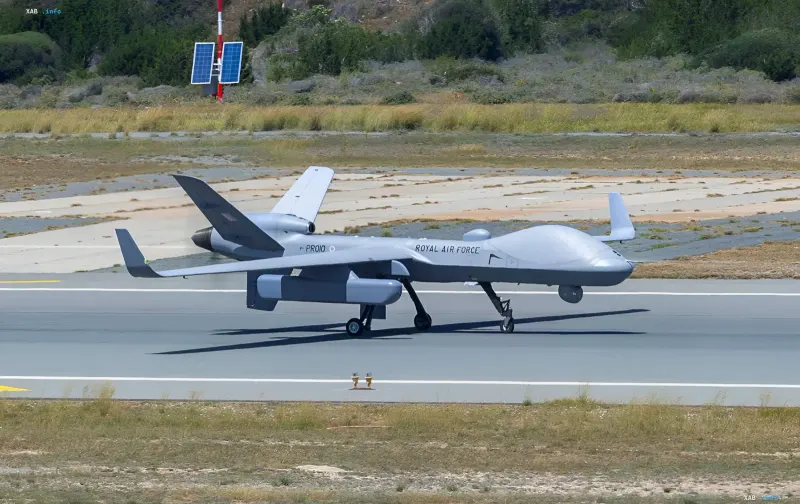
The UK Royal Air Force has deployed the Protector RG Mk1 unmanned aerial vehicle for operational surveillance of Russian military ships in British airspace for the first time. The flights took place between late September and mid-October 2026, collectively providing more than ten hours of continuous monitoring of Russian vessel movements. London officially reported on completed missions rather than an ongoing operation. According to the UK Ministry of Defence, the drone was unarmed during the flights, and the use of weapons was not considered.
Joint Operations with the Fleet: Destroyer, Patrol Ship, and Frigate
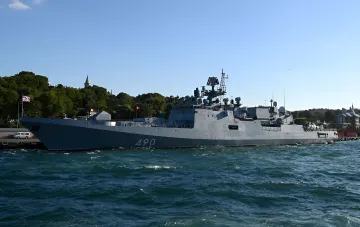
The drone operated in coordination with Royal Navy ships and helicopters tracking the movements of Russian vessels. Specifically, from October 1 to 14, the destroyer HMS Dauntless and the patrol vessel HMS Tyne monitored the Russian frigate Neustrashimyy and several commercial ships in the English Channel. Commander of 13 Squadron Sam Gailey stated that the Protector's first operational flights in British airspace confirmed the value of this system for national defense. According to him, the aircraft is capable of supporting maritime security by operating simultaneously in military and civil airspace.
What is the Protector RG Mk1: Specifications and Armament
The Protector RG Mk1 is the British designation for the American MQ-9B SkyGuardian manufactured by General Atomics Aeronautical Systems. It is a medium-altitude, long-endurance drone with a wingspan of 24.07 meters. The propulsion system is a 900 hp Honeywell TPE331-10T turboprop engine. The mission crew consists of a remote pilot, sensor operator, and intelligence coordinator. Among the onboard systems, the RAF highlights a synthetic aperture radar and the AN/DAS-4 multispectral targeting system. The Ministry did not disclose the specific sensor configuration or modes used during the maritime flights. Britain has ordered 16 aircraft, 11 of which have already been delivered. Based at RAF Waddington, the drone performs reconnaissance, surveillance, target acquisition, target tracking, maritime observation, search and rescue, and civilian authority support operations. The RAF armament list includes Brimstone 3A missiles and Paveway IV guided bombs, but the aircraft that flew over the English Channel was unarmed.
First Flight Through European Civil Airspace
Access to civil airspace provides the drone with operational flexibility emphasized by the RAF. On June 11, 2026, the Royal Air Force reported the first flight of a Protector through European civil airspace: from Waddington to RAF Akrotiri. The aircraft covered over 2,000 nautical miles in approximately 13.5 hours through the airspace of France, Italy, Malta, and Greece. This episode demonstrated the drone's ability to perform long-range transit missions without relying on military airfields in intermediate countries.
Context: Growing Fleet Activity and Publication Limits
According to the UK Ministry of Defence, in the first seven months of 2026, the number of Royal Navy operations monitoring Russian activity increased by 25% compared to the same period last year. Flights over the English Channel, according to the department, complement ships and helicopters with long-term surveillance. However, improvements in target detection or reductions in helicopter deployments were not quantitatively assessed. The report also does not confirm continuous coverage, anti-submarine detection, or new strike capabilities during these missions.
Broader Context: Sanctions Pressure and Defense Initiatives
Maritime surveillance fits into the broader context of British policy regarding Russia. On September 22, 2026, Britain test-fired a torpedo from a drone; on October 1, it introduced a new package of sanctions targeting the "shadow fleet." On October 9, the country reported inventing an unusual method to protect submarines from drones. On October 23, the British government urged citizens to stock three days' worth of water and food, and on October 27, the Defense Minister stated that the UK has just over 1,000 days to prepare for a potential conflict with Russia.