RBC-Ukraine, citing an investigation by the Russian Anti-Corruption Foundation (FBK), reports that massive Ukrainian drone strikes on the infrastructure of Ozon, Russia's second-largest marketplace, are causing direct financial damage to Vladimir Putin's personal fortune. According to the investigators, the strikes on the logistics complexes hit not just a commercial structure but assets that, in their assessment, form part of a hidden system for storing the president's personal funds, distributed among his closest circle.
The financial chain: from 'O23' to 'Optima' and 'Delta'
Ozon's official largest shareholder, according to FBK, is the company 'O23', which owns 34% of the shares and bought them from the international investment fund Baring Vostok. The publicly declared ultimate owner of this stake is Russian businessman Alexander Chachavu; however, analysis of the financial reporting, the analysts claim, shows that he is merely a front man. The 38 billion ruble buyout agreement is routed through a chain of legal entities: to execute the deal, the company 'Stratosfera' took out a 51.2 billion ruble loan, and in Russian accounting records the only structure that issued a loan of the same amount turned out to be OJSC 'Optima'. The source of these 51.2 billion rubles for 'Optima', according to the investigation, was an interest-free loan from the firm 'Delta', officially owned by Russian oligarch Gennady Timchenko.
Who is behind 'Optima': the president's circle
FBK analysts found that the management of 'Optima' consists entirely of trusted figures from the Russian president's entourage. The company's CEO Darya Brylyakova and her predecessors, according to the investigation, worked in the business structures of Putin's nephew Mikhail Shelomov, oligarch Yuri Kovalchuk, and the president's former lover Svetlana Krivonogikh. Timchenko, for his part, is characterized by the investigators as one of the main custodians of Putin's so-called 'common pot' (the 'obshchak'): previously, through his firms, according to their data, other assets were purchased, in particular the brewing company 'Baltika', and the construction of residences and the private needs of the president's family were financed. 'Neither Vladimir Putin's name nor his accounts show any stolen billions. The system is set up differently: personal money is kept by close friends who act as wallets, to whom he has handed out pieces of the economy,' the authors of the investigation note.
War as a tool for redistributing assets
The investigators emphasize that the war has become a cover for the Russian leadership for a large-scale redistribution of assets: foreign business is being pushed out of the country, and its property ends up under the control of Putin's circle. Massive strikes on logistics complexes in Russia, according to their data, have been ongoing since mid-summer 2026. First, the facilities of the largest marketplace Wildberries came under systematic attacks, losing, by estimates, 40% of its warehouse space with damages of one trillion rubles. Subsequently, Ukrainian drones began striking Ozon warehouses — in particular, in Samara Oblast, Makhachkala, and Adygea.
The Kremlin's reaction and ongoing incidents
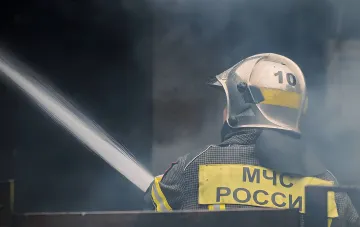
The Kremlin has previously issued threats against Ukraine over the attacks on civilian infrastructure. In particular, the president's official spokesperson Dmitry Peskov stated intentions to carry out regular strikes on Kyiv, accusing the Ukrainian side of the attacks on the Ozon marketplace. Meanwhile, large-scale incidents continue at logistics facilities within the Russian Federation: recently, in the city of Blagoveshchensk, which in the original text is attributed to the Republic of Bashkortostan, a fire broke out at an Ozon warehouse following reports of explosions, although local authorities have not yet named the official cause of the fire.
Contradictory data
The provided sources contain inconsistencies in the geography of the incidents. In the base text, the fire at an Ozon warehouse is linked to the city of Blagoveshchensk 'in the Republic of Bashkortostan', which is geographically incorrect: Blagoveshchensk is located in Amur Oblast, whereas Bashkortostan is home to Ufa and Sterlitamak. At the same time, other sources point to drone attacks on Ozon warehouses in Ufa, Orenburg, and Sterlitamak, as well as a fire in Samara Oblast with casualties. Thus, the list of specific cities where Ozon warehouses burned differs across publications. Moreover, the link between the damages to Ozon and Putin's personal fortune is a claim of the FBK investigation and has not been officially confirmed either by the Russian authorities or by Ozon itself; only the drone-attack incidents and warehouse fires remain officially confirmed.