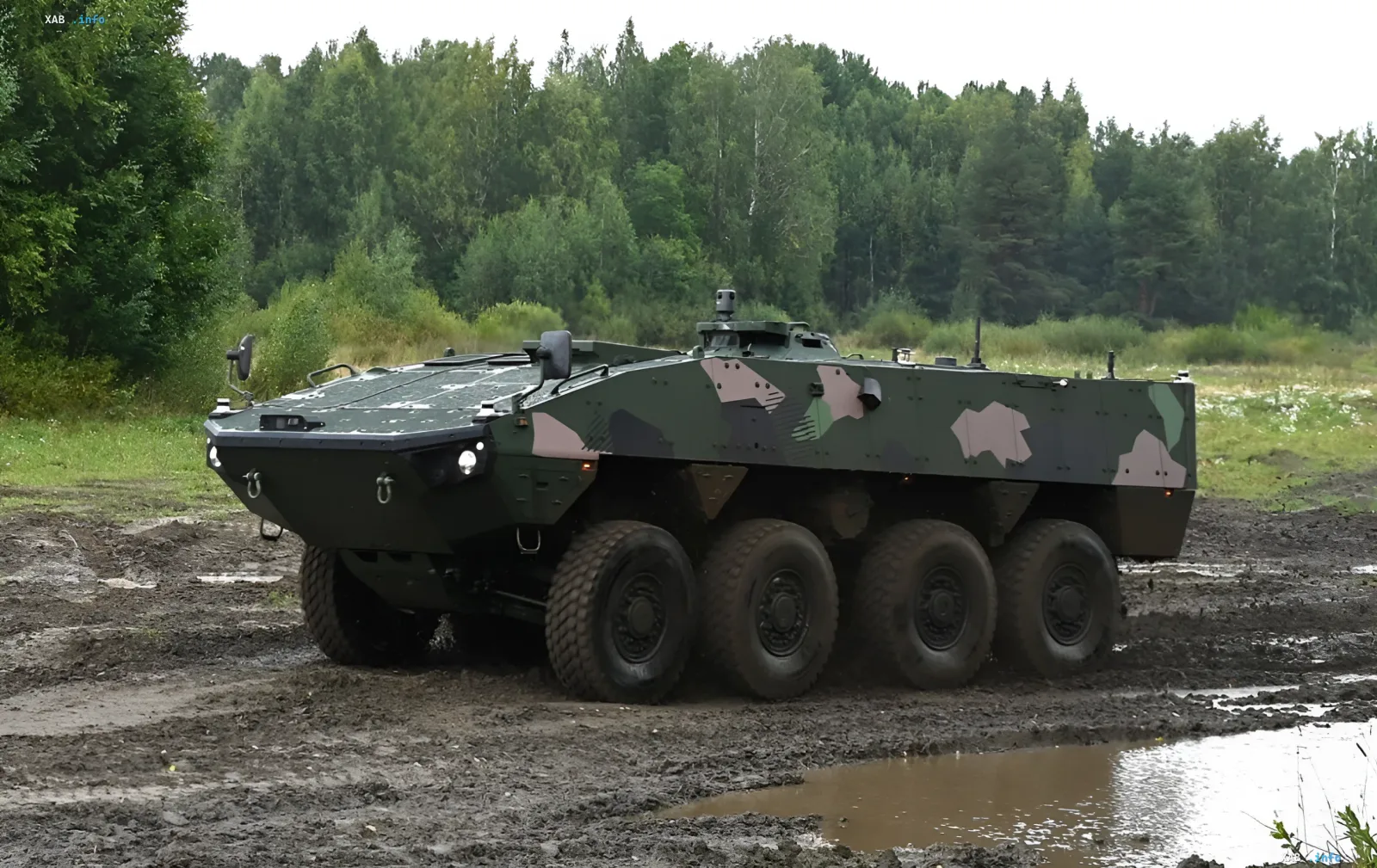
Finnish defense company Patria conducted a public demonstration of remote control of a wheeled AMV armored vehicle, with operators located in Tokyo and the vehicle itself on the Parola military test range in Finland. The distance between the control point and the target exceeded 7,800 kilometers. This is reported by RBC-Ukraine, citing Patria's press service. The demonstration was organized with the support of the Embassy of Finland in Japan and combined into a single concept network-based vehicle control, secure 5G connectivity, and real-time situational awareness.
Technological Architecture: 5G, Nokia, and Situational Awareness
According to the company, remote control was made possible by reliable data transmission channels and a modern armored vehicle platform. Working in conjunction with Patria were Nokia technologies providing the telecommunications infrastructure, as well as SAVOX and Basemark solutions responsible for communications and the operator's visual awareness. It was precisely the integration of these components that allowed the operator in Tokyo to receive an up-to-date picture of the vehicle's surroundings and issue movement commands in real time, despite the intercontinental distance.
Applied Scenarios: From Logistics to Autonomous Navigation
Patria emphasizes that the demonstrated concept opens the way to a number of applied scenarios: unmanned logistics operations, column escorting, and autonomous navigation along predefined route waypoints. The company notes that remote control requires a deep understanding of the vehicle's condition, its immediate surroundings, and the broader operational environment, which is why the project employs a comprehensive set of technologies rather than a single solution. Patria states that it has been developing unmanned and remotely controlled capabilities for several years and continues to refine next-generation technologies, including artificial-intelligence-based solutions.
Context: Patria in Ukrainian and European Armaments
The demonstration takes place against the backdrop of Patria vehicles' active presence in European armies. Several dozen Patria 8×8 armored personnel carriers were previously transferred to Ukraine by allies — in particular, Finland and Latvia. Since 2024, serial production of the Patria 6×6 has been launched in Latvia at a new plant in Valmiera; the project is being implemented in cooperation with Finland, and the first batch has already entered the service of the Latvian army. In addition, the Ukrainian enterprise "General Cherevnya" and Finnish Patria signed a memorandum of cooperation in the field of unmanned systems: the parties plan to produce Ukrainian drones in Finland for the needs of Ukraine and Europe.
Contradictory Data
In the original RBC-Ukraine text, there is a terminological inconsistency: the remote control demonstration was carried out on a vehicle designated as the "Patria AMV" (which traditionally corresponds to the 8×8 configuration), yet the following paragraph gives a detailed description of the Patria 6×6 — a different, more compact wheeled chassis. Meanwhile, the accompanying image shows a vehicle whose running gear configuration and hull layout could correspond to either the 6×6 or the 8×8 variant. The exact modification that participated in the demonstration from Tokyo is not unambiguously specified in the press release, creating uncertainty for the reader. Pending clarification from Patria itself, both variants — AMV 8×6/8×8 and 6×6 — remain possible.
Significance for the Defense Industry
Regardless of the exact chassis modification, the test conducted confirms the viability of the concept of intercontinental remote control of combat vehicles via commercial 5G infrastructure. For defense customers, this means a potential reduction in risks to personnel when performing tasks in hazardous zones, and for manufacturers — a new class of requirements for platforms: reliable telemetry, redundant communication channels, and autonomous decision-making algorithms. Patria, positioning itself as a developer of "next-generation technologies," is in effect setting a direction in which the classic armored personnel carrier is transformed into a node of a distributed control network.