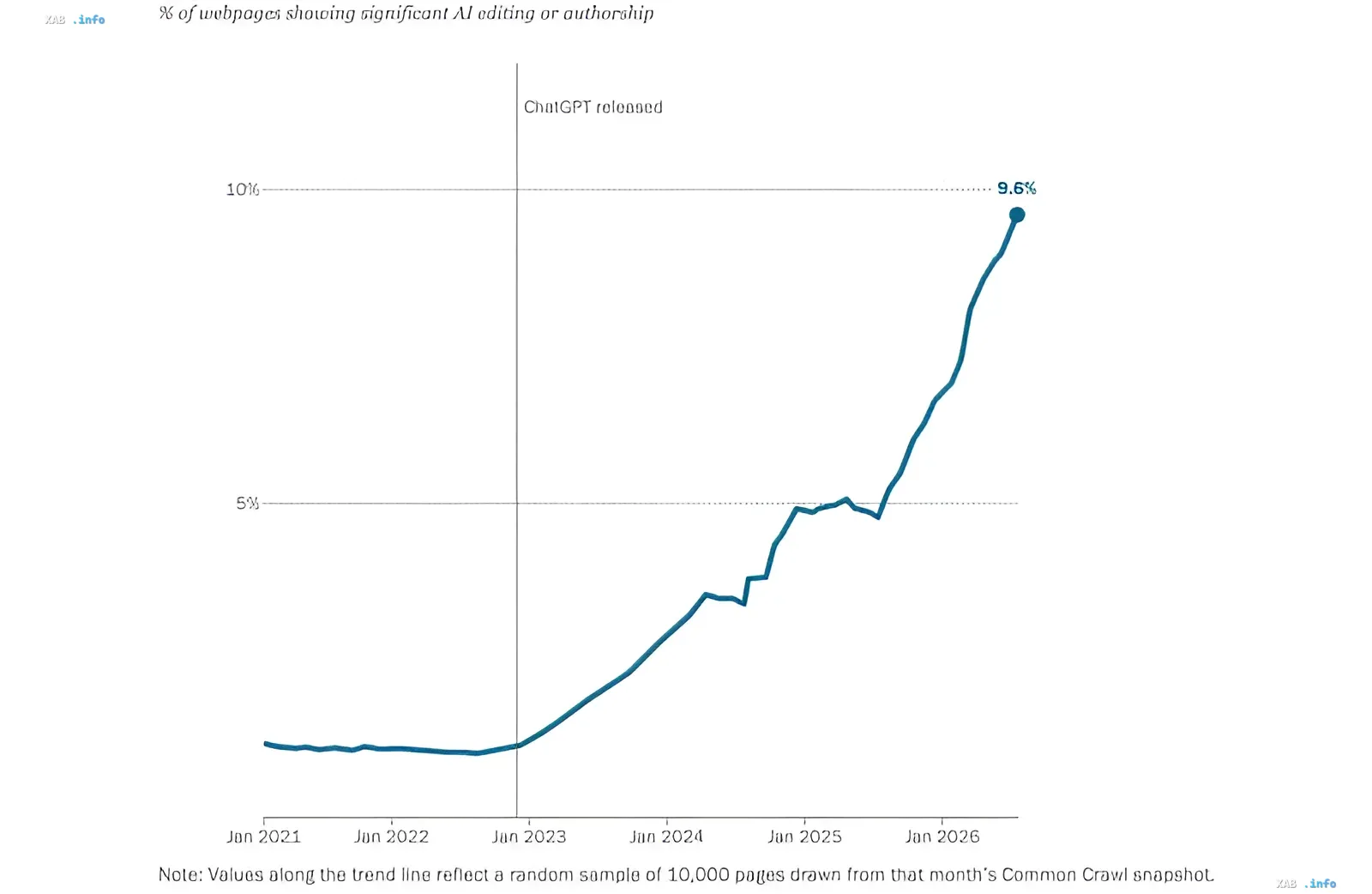
The American research firm Pew Research has published a large-scale study examining how far artificial intelligence has already penetrated the English-language segment of the internet. The key finding: more than a third — estimated by analysts at 35% — of web pages published after the release of ChatGPT in November 2022 contain significant signs that the text was written or substantially edited with the help of AI. For context: in a random sample of 10,000 pages saved in July 2026, about 10% of resources showed "significant signs of AI authorship" (this point is marked as 9.6% on the study's chart). The difference between the two figures is explained by the fact that the overall sample inevitably includes older pages created before the emergence of generative text models, whereas in the filtered "post-ChatGPT" sample the share of AI content rises sharply.
Methodology: how Pew Research counted AI texts
To conduct the analysis, the researchers used the Common Crawl web archive, from which they extracted nearly half a million web pages published over the past five years — starting from a period a couple of years before ChatGPT's release. The determination of the share of AI authorship was performed using the Open Pangram technology, which assesses the probability that a text was generated or substantially reworked by a neural network based on stylistic and statistical markers. Importantly, the study answers the question of what material is presented on the pages, not who or what is viewing those pages — this is a fundamental distinction from bot-traffic data.
35% of new content: what the numbers say
After pages created before the emergence of text-generation tools were excluded from the sample, the share of resources with signs of AI authorship in the updated sample amounted to more than a third — 35%. This means that, in effect, every third new English-language web document that appeared after November 2022 is, with high probability, somehow connected to the work of a language model. The dynamics on the Pew Research chart clearly show exponential growth: the curve remains virtually flat until the release of ChatGPT, then begins to rise steadily, accelerating in 2025–2026 and reaching the 9.6% mark in the overall sample by July 2026.
The gap between commercial and institutional sites
The study revealed a pronounced uneven distribution of AI content across domain zones. Sites in the .com zone show signs of AI authorship roughly ten times more often than resources in the .edu or .gov zones — for the latter, this figure is about 1%. On domains in the .org zone, AI "left its mark" in 4.6% of cases. Thus, the commercial and news segments of the internet have been affected by text automation significantly more than the academic and government segments, where content-creation processes remain predominantly human.
Bots reading bots: the traffic context
The Pew Research results logically complement a recent statement by Cloudflare that bot-generated web traffic has exceeded the volume of traffic generated by humans — and this happened sooner than the company itself had expected. The combination of the two facts paints an alarming picture: bots not only read the internet, but increasingly read material written by other bots. This creates a closed loop in which machine-generated content is consumed by machines, which can distort both search results and the training data of future models.
Contradictory data
A number of figures in the study require cautious interpretation, and there are several inconsistencies that should be honestly pointed out. First, the 9.6% figure (the overall random sample of 10,000 pages from July 2026) and the 35% figure (only post-ChatGPT pages) describe different slices of the data and cannot be compared directly — the first number includes "historical" content, the second only new content. Second, the Open Pangram tool, like other similar detectors, can produce false-positive results, indicating signs of AI authorship even where the text was honestly written by a human. In a large sample the statistics are generally considered accurate, but point estimates for individual sites may be overstated. Finally, Pew Research's data on content authorship are not identical to Cloudflare's data on bot traffic: these are adjacent but different measurements, and conflating these two streams in public discussion can lead to incorrect conclusions about the "share of AI on the internet."
Taken together, the Pew Research study marks a turning point: four years after ChatGPT's launch, artificial intelligence has ceased to be a niche tool and has become a systemic participant in shaping the English-language web. For editors, SEO specialists, and regulators, this means that questions of authorship transparency, labeling of AI content, and the quality of machine-generated texts are moving to the forefront of the agenda.