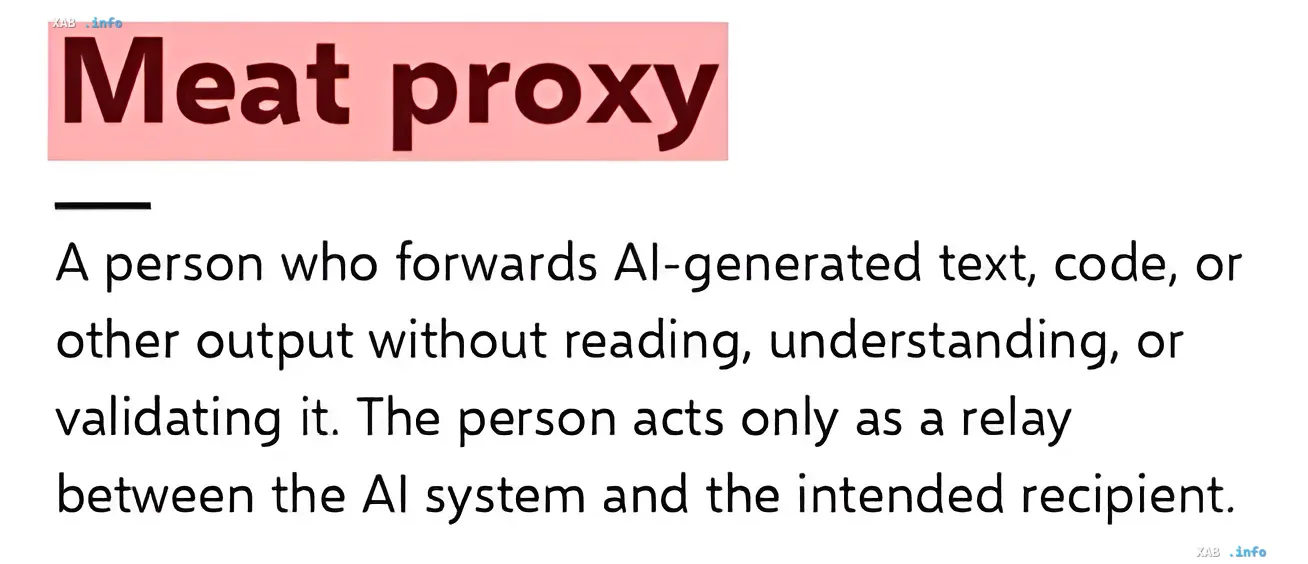
In the lexicon of tech corporations and startups, a new, essentially derogatory term is rapidly gaining popularity — Meat Proxy. In professional circles, this is the dismissive label for colleagues who have fully delegated their thinking process to generative AI, leaving themselves with nothing but the mechanical function of pressing Ctrl+C / Ctrl+V. According to fact-checking data, the concept is going viral on platforms like Hacker News, X (formerly Twitter), and LinkedIn, while Business Insider and Mashable have published analytical breakdowns of the phenomenon. The term grew out of science fiction — "meatbag," what robots call humans — and from the server-side word "proxy," meaning an intermediary that merely forwards data packets without altering them.
Anatomy of the phenomenon: how to spot a "meat proxy"
The scenario of interacting with such employees, as described in discussions, is the same worldwide. You ask a colleague a work question in a corporate messenger or request a code review and a technical specification. A couple of minutes later you receive a bloated, unnaturally polite text of several paragraphs with lists, emojis, and the characteristic "neural-network bird language" — boilerplate phrases like "in today's fast-changing world." And when you try to ask a clarifying question, the other person freezes, because they haven't even read what they sent you and are once again rushing to the chatbot window for a prompt. In essence, the person becomes a live cable between the model's server and your monitor.
Why this has become a problem for business
The emergence of the term has exposed a deep crisis of productivity and trust within digital teams. The main complaint from colleagues boils down to the fact that such employees create no added value: "I can ask Claude myself, setting up the context directly, and I don't need a flesh-and-blood intermediary for that." Instead of using AI as an assistant for drafts and brainstorming, some mid- and junior-level employees start working as a "buffer" between two browser windows, and companies are effectively paying full salary to a person who brings no independent judgment, fact-checking, or personal accountability. In engineering circles this has already sparked irritation in code reviews: seniors complain that they are forced to catch subtle model errors while juniors simply "proxy" their remarks back into the neural network.
Contradictory data
However, there is no consensus around the term, and the versions on both sides diverge. Critics argue that blindly forwarding raw model output is a degradation of expertise and a shifting of all the work of validation and finding logical errors onto the recipient, turning work correspondence into "two AI agents communicating through tired humans." On the other hand, defenders of normal AI use point out that the mere fact of turning to ChatGPT, Claude, or Gemini does not make a person a "proxy": delegating routine drafts to the model is standard practice, and the term is often thrown around as a label without evidence, substituting for any work with a neural network. Thus, in the debate it is not so much facts as assessments that clash: where is the line between "AI as an assistant" and "human as a relay"?
How not to become a "meat proxy" yourself
Productivity experts and team leads formulate a simple "added-value rule": AI generates raw material, and the human delivers the judgment. If before sending a reply you have not re-checked the facts, rewritten the text in your own words for your team's context, and are not ready to personally stand behind every point — you are working merely as a "live cable" between OpenAI/Anthropic's server and your monitor. It is precisely this personal accountability and critical reflection, not the mere fact of using a neural network, that separates an expert from a "meat proxy".