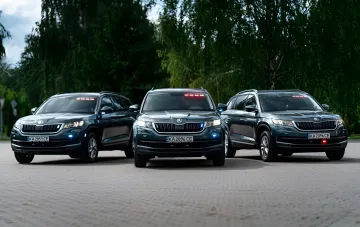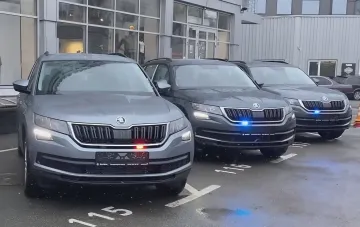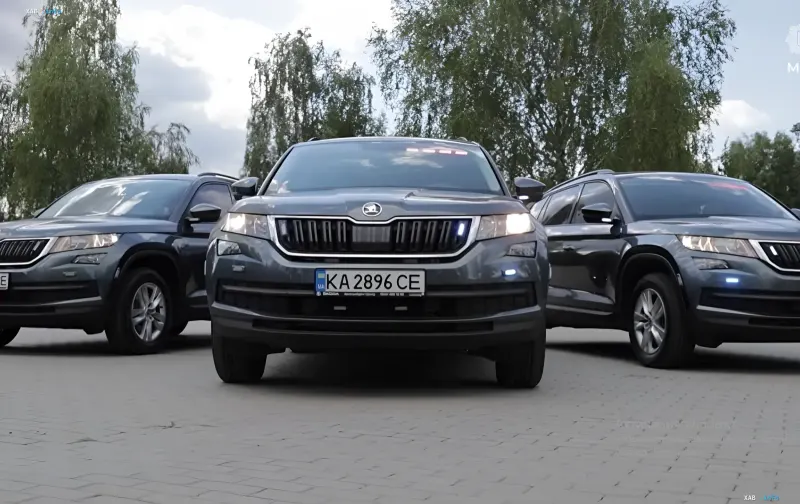
As of August 31, 2026, hidden patrol vehicles are once again operating in Kyiv and Kyiv Oblast. The Ministry of Internal Affairs (MIA) calls them “Phantoms.” On the outside, they are unremarkable gray first-generation Skoda Kodiaq crossovers in pre-facelift trim, indistinguishable from an ordinary civilian car in traffic. Inside, however, is an automated software-hardware complex that independently measures speed, recognizes license plates, and transmits data to the automated violation detection system. In essence, these are Ukraine’s first “police robots”: the country has nothing more automated on the front lines of road safety yet.
What Is a “Phantom” and Why the Project Was Relaunched
The idea is not new: mobile hidden speed control has long been used in a number of developed countries. The National Police of Ukraine received its first pilot batch of such vehicles back in 2020; after testing, adaptation, and certification, they went on full routes in January 2022, but due to the full-scale invasion they operated for only about a month. In that short period, four vehicles recorded more than 26,000 speeding violations. Now the project has been resumed: according to the MIA, three vehicles from that same original pilot four have been back on the line since late August, and the first week of operation showed that the system has not lost its effectiveness.
How Hidden Control Works: Up to 50 Targets in Traffic
The key difference between a “Phantom” and a stationary camera is that it works with traffic flow, not a single point. The vehicles are equipped with two video cameras through which the electronics see the surroundings, independently pick out speeding vehicles in the flow, and record their plates and photos. The complex can track up to 50 moving targets simultaneously. The data is sent via mobile internet to the same automated detection system used by stationary road cameras: an analytical center prepares the case file, and an authorized officer, after verification, issues an administrative fine decision. Like the stationary cameras, the system is set not to the legal speed limit but to a higher threshold, accounting for the so-called unpunishable bonus of about 20 km/h.
The Psychology of Prevention: Why a Driver Cannot “Catch” the Police
A regular patrol car warns by its appearance: you see the police and take your foot off the gas. The “Phantoms” work on a different logic. Knowing that such “undercover” units are operating in a city, region, or highway stretch, a driver has no way of knowing whether such a vehicle is nearby. Therefore the system does not limit speed only where the police are visibly present but constantly creates a deterrent: exceed the limit and you may be penalized at any moment. That is precisely why the police position the “Phantoms” primarily as a preventive tool rather than a means of punishment.
Contradictory Data
There is a notable mismatch here between the stated ambitions and the actual scale. As early as 2022, the MIA spoke of purchasing 30 such vehicles that same year and 110 in 2023, treating the “Phantoms” as the foundation of a large-scale mobile system rather than four experimental cars. Reality is different: only the pilot four was on the line at the time, operating for about a month, and in 2026 the project was relaunched with just three vehicles. In other words, the declared scale of dozens and hundreds of units was never achieved, and current operations remain at the level of the original pilot. The gap between the “plan for 110” and the “reality of 3” is the main dissonance in this story.
What the Offender Receives: From Camera to Letter
The violation is recorded automatically, with no human involvement in form and without stopping the vehicle. After verification, the case file becomes a decision: a printed letter is sent by mail to the owner’s registered address, and the fine additionally appears in the driver’s personal account at the MIA service center and in the “Diia” app. To confirm it, photos and a QR link to a short video of the vehicle at the moment of the violation are attached. In terms of cost: the four Skodas cost 3.7 million UAH at the time, and the set of European-made equipment cost another nearly 3.0 million UAH — meaning the price of integrating a single vehicle into the nationwide control system is comparable to the price of the car itself.