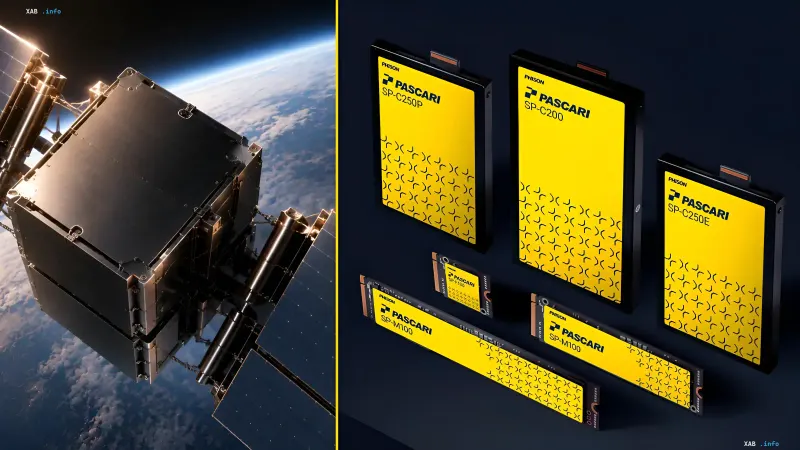
Phison has officially unveiled the Pascari Space solid-state drive lineup, designed specifically for operation in space environments. The new SSD family is intended for spacecraft, satellites, and orbital data centers. The key project utilizing these drives is the StarVault-001 orbital data center, developed by Lonestar Data Holdings. The launch of the complex to low Earth orbit is expected in the first half of 2027, making Pascari Space one of the first mass-produced serial data storage solutions for space.
StarVault-001: 488 TB of Storage in Orbit
The StarVault-001 orbital data center will feature a total of 488 TB of flash memory. Once the system is fully deployed in low Earth orbit, users will have access to approximately 370 TB of usable capacity. It is important to emphasize that this refers to the aggregate volume of all drives within the data center, rather than the capacity of a single device. This approach allows significant computing and storage capacities to be placed directly in orbit, reducing latency in processing data received by satellites and other spacecraft.
Three Categories of Drives for Different Tasks
The Pascari Space lineup is divided into three functional categories: Flight Critical, Main Storage, and Orbital Data Center. The first two categories feature PCIe 4.0 interfaces with capacities ranging from 40 GB to 4 TB, designed for mission-critical flight control systems and onboard data storage. The third category, Orbital Data Center, utilizes the more modern PCIe 5.0 x4 interface and includes models with significantly larger capacities: SP-C200 with up to 128 TB, SP-C250P with 32 TB, and SP-C250E with 25.6 TB. All Orbital Data Center drives are available in E3.S and E3.L form factors, ensuring compatibility with server platforms adapted for space applications.
IMAGIN+ Engineering Support and Error Correction Algorithms
Each drive is tailored to a specific space mission through IMAGIN+ engineering services. The service package includes firmware customization, radiation testing, error handling mechanism adjustments, and data retention parameters. The SSDs employ LDPC, SmartECC, and SmartRefresh error correction algorithms to ensure reliable data storage under space radiation conditions. Phison also notes that switching to pSLC mode instead of the standard TLC configuration in Flight Critical and Main Storage models increases write endurance by up to 60 times, which is critical for long-term missions with limited hardware replacement capabilities.
Temperature Ranges and Radiation Assessment
Various models in the lineup feature different operating temperature ranges corresponding to orbital and deep space conditions. The Flight Critical SP-F100 drive is rated for −40 to 105 °C, the Main Storage SP-M100 for −40 to 85 °C, and the Orbital Data Center models for 0 to 70 °C. In addition to standard supply, Phison offers separate radiation assessment and hardware verification services tailored to specific mission requirements, allowing customers to obtain drives certified for specific space radiation levels.
Phison’s Experience in Space Projects
Phison already has a proven track record in space data storage systems. Previously, the company's technologies were used in projects involving Mars rovers, and in 2025, Phison partnered with Lonestar Data Holdings to send data center hardware to the Moon. The introduction of the Pascari Space lineup and its integration into StarVault-001 logically continue this trajectory, positioning Phison as a key supplier of data storage solutions in the new era of orbital computing infrastructure.