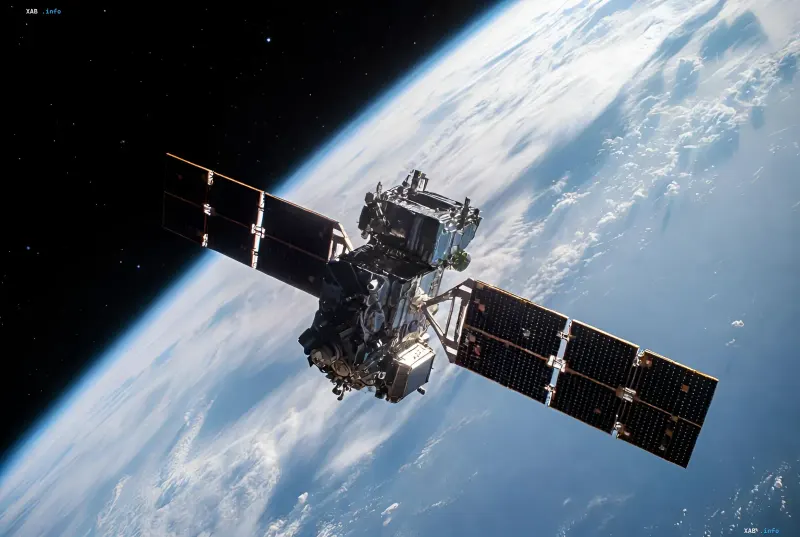
Boeing, a company that for decades has been primarily associated with civil and military aviation, has announced the development of the Q4S satellite — a vehicle designed to test one of the key technologies of the future quantum internet. We are talking about the transmission of quantum entanglement between remote network nodes, a mechanism without which global quantum communication remains only a theoretical construct. It is notable that the project is funded exclusively by Boeing's own capital, without any government contract or grant. The apparatus is being created jointly with HRL Laboratories, a research unit specializing in advanced technologies for the defense and space sectors.
Entanglement Swapping: The Mechanism That Connects the Network
The central element of the Q4S experiment will be so-called entanglement swapping. In orbit, the satellite will generate two separate pairs of entangled photons — particles whose quantum states remain interconnected even at significant distances. The device will then perform a procedure in which two photons that had not previously interacted with each other become quantumly entangled. This specific mechanism allows for the "transfer" of quantum connectivity from one network node to the next, like a relay race: each node receives entanglement from the previous one and passes it to the next, forming a continuous chain. Without entanglement swapping, the quantum internet would be limited to pairwise links between two points rather than a distributed network.
Orbit Experiment: One Year in Microgravity
The entire cycle of experiments is planned to be conducted directly in orbit rather than on Earth. The duration of the orbital phase is estimated to be approximately one year — enough time to accumulate a statistically significant volume of data on the quality and stability of entanglement swapping in real space conditions. The choice of an orbital platform is due to the fact that ground-based communication lines between quantum nodes are limited by signal attenuation in fiber-optic lines: at distances over a few hundred kilometers, losses become critical. A satellite, by contrast, allows for these limitations to be overcome by using free space as a transmission channel for photons.
Chronology: From Flight Tests to 2027 Launch
The project has already passed several important milestones. In June 2026, Boeing conducted tests of the entanglement swapping technology on flight hardware, that is, on a hardware platform as close as possible to the one that will be installed on the satellite. The payload successfully passed qualification tests for space application, including checks for vibration and thermal loads, and was moved to the final assembly stage. The launch of Q4S is scheduled for 2027. Thus, less than a year and a half has passed from the first successful flight test to the launch of the apparatus into orbit — a pace characteristic of commercial rather than government space programs.
Why Boeing Invests Its Own Money
For Boeing, this is an unconventional step. The company, whose primary revenue is generated by the supply of aircraft, avionics, and aerospace technology, is directing its own funds to verify a technology that lies at the intersection of quantum physics and space engineering. The absence of a government contract means that Boeing assumes full technological and financial risk: if the experiment does not yield the expected results, the investments will not be compensated from the budget. At the same time, the successful demonstration of entanglement swapping in orbit opens up access for the company to a whole class of future orders — both commercial and defense-related — associated with the construction of quantum infrastructure.
What the Quantum Internet Will Offer in the Future
In the long term, quantum networks promise several practical advantages. First, more precise time synchronization for navigation systems, which is critical for civil and military infrastructure. Second, communication channels protected from interference at a fundamental physical level: any attempt to intercept a quantum signal inevitably disturbs the state of the photons and is detected. Third, the ability to combine quantum sensors and quantum computers over long distances, creating distributed computing and measurement systems. The Q4S project is expected to show how realistic it is to implement such an infrastructure using satellite platforms — and thus determine whether the quantum internet will become the next stage of global telecommunications architecture.