The U.S. space agency NASA has announced the launch of the AMPERE (Advanced Mid-Power Electric Rocket Challenge), aimed at accelerating the development of mid-power electric Hall-effect thrusters. The total funding for the project is $500,000: the agency plans to select two winners, each receiving up to $250,000. In addition to the cash prize, the winners will gain access to NASA's internal developments and the opportunity to test their prototypes at the agency's facilities free of charge. The challenge is the first in the Tech Maturation Prize series, launched by NASA to systematically accelerate the maturity of key space technologies.
Why mid-power Hall thrusters are a strategic niche
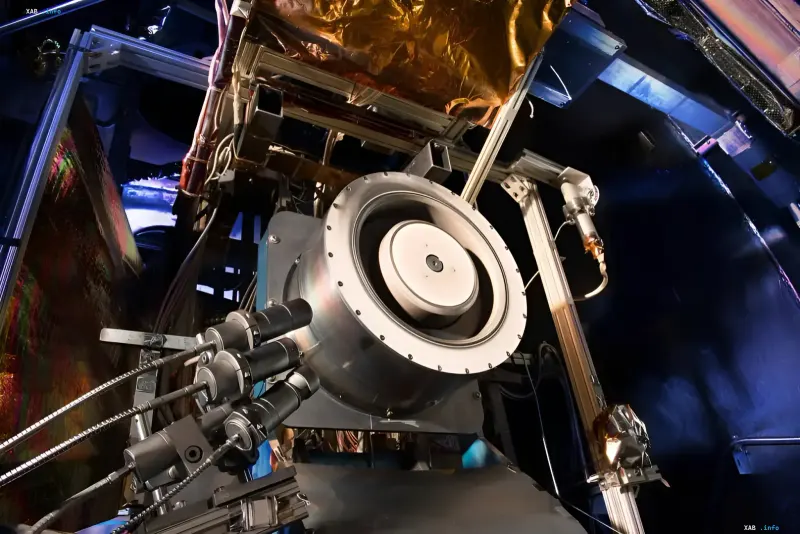
Hall-effect thrusters operate by accelerating ionized propellant using an electric field, which generates thrust with extremely low fuel consumption compared to chemical engines. Today, such systems are widely used for satellite orientation and station-keeping, as well as on robotic spacecraft. However, most existing production Hall thrusters are in the low-power class. NASA views the transition to mid-power as a critical step: these engines will be capable of providing sufficient thrust for heavier payloads, long-duration interplanetary flights, and future government and commercial missions, without requiring a massive increase in fuel mass.
Three stages from concept to testing in Cleveland
The AMPERE challenge is structured into three consecutive stages. In the first stage, participants submit a thruster concept, a production plan, and calculations of costs and key specifications. In the second stage, the selected teams begin developing prototypes in collaboration with NASA experts. An important incentive at this stage is the opportunity to receive royalty-free licenses for early-use Hall thruster technologies developed by the agency and designed for use with krypton as a propellant. The final stage involves practical testing of the prototypes at the NASA John H. Glenn Research Center in Cleveland, Ohio.
What winners receive beyond funding
For private developers, the key value of the AMPERE challenge is not just the cash prize, but access to NASA resources. Winners have the opportunity to work with agency experts, utilize state-of-the-art testing complexes, and obtain royalty-free licenses for early-stage Hall thruster technologies. This format lowers the entry barrier for small companies that would otherwise be unable to afford vacuum chambers and test stands for electric propulsion systems. Free access to the Glenn Research Center infrastructure effectively turns the challenge into a collaborative development program, where NASA acts not only as a customer but as a technological partner.
AMPERE in the context of the Tech Maturation Prize series
The AMPERE challenge is the first in the Tech Maturation Prize series, a new NASA initiative aimed at accelerating the transition of technologies from the laboratory stage to flight-ready implementation for real missions. The project is co-managed by the Glenn Research Center and the Jet Propulsion Laboratory (JPL), ensuring a comprehensive approach: from fundamental research on ion thrust to applied engineering solutions. Launching AMPERE as a pilot for the series sets a format that the agency intends to replicate for other technology areas — from life support systems to new materials for spacecraft. Thus, the $500,000 allocated for AMPERE is not just the budget for a single competition, but an investment in a mechanism that NASA intends to scale across its entire portfolio of emerging technologies.