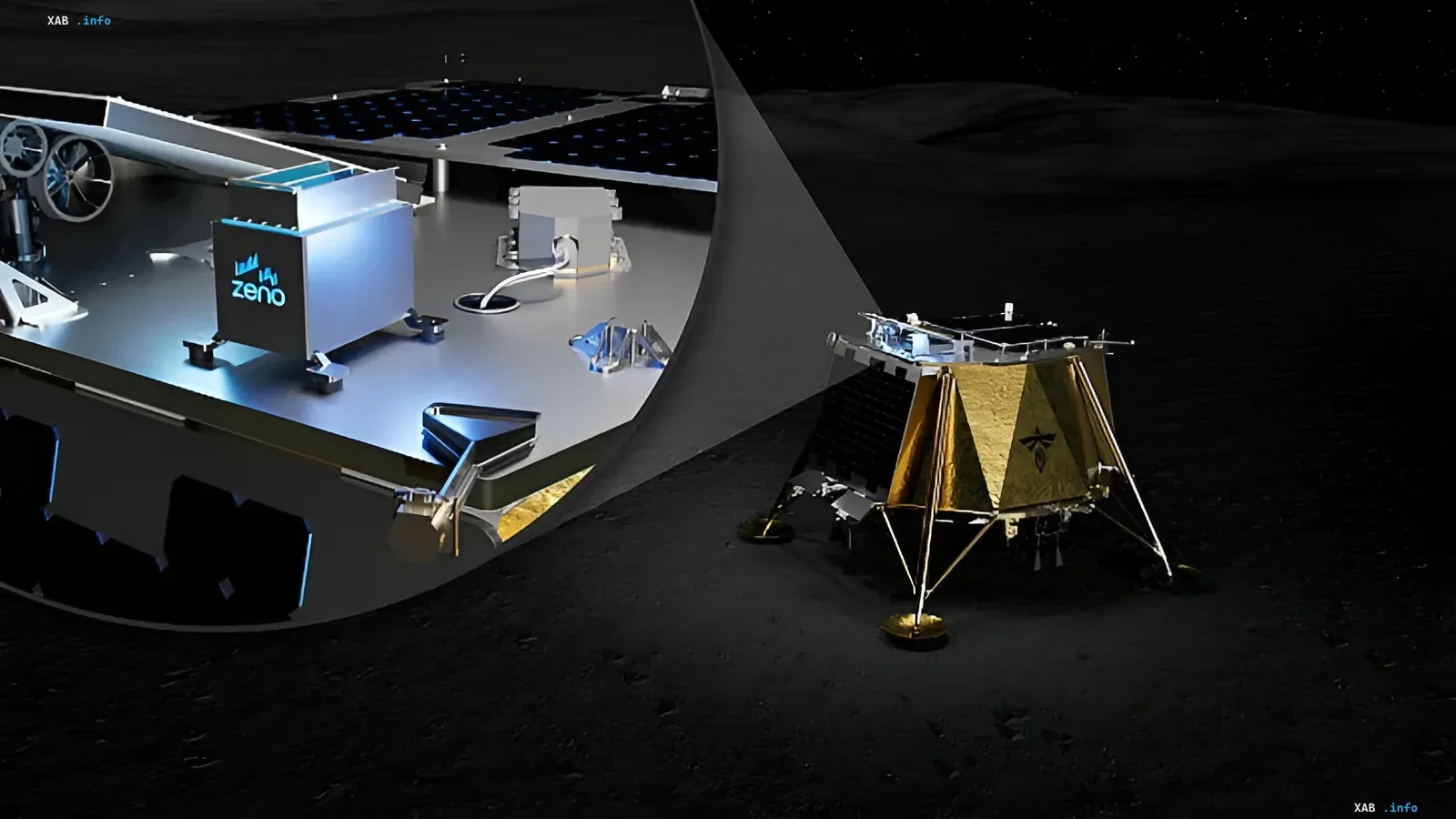
Firefly Aerospace and Zeno Power Systems have announced preparations for a joint technology demonstration aimed at solving one of the key challenges of NASA's lunar program — keeping onboard equipment operational during the extreme cold of the lunar night. Under a commercial agreement, the Blue Ghost lunar lander will deliver to the lunar surface a radioisotope heating unit (RHU) based on americium-241. The mission launch is planned for no earlier than 2028 as part of NASA's current commercial lunar exploration program.
Five Watts Against Minus 133 Degrees
The main goal of the experiment is to verify the ability of the new heating equipment to operate continuously throughout the 14-day lunar night, when the absence of an atmosphere causes the surface to cool rapidly. Near the equator, temperatures can drop to approximately −133 °C, while in permanently shadowed polar craters the figures are even lower. Zeno's radioisotope heater will emit about 5 W of thermal power through the natural radioactive decay of americium-241, providing a constant heat source independent of sunlight. It is precisely this autonomy that makes the technology critically important for any missions designed to operate beyond the lunar day.
Mission Profile: From Solar Day to Nuclear Night
The Blue Ghost payload will include not only the thermal element itself but also a support platform equipped with power, communications, control, data processing, and thermal regulation systems. After landing, the spacecraft will first carry out NASA's primary science program during the lunar day, using solar panels. Then, once the sun sets below the horizon, Zeno's radioisotope unit will continue operating in autonomous mode, transmitting data on the equipment's condition back to Earth. Thus, the mission will become a full flight test of the technology under real lunar conditions, rather than a mere laboratory demonstration.
Why Americium-241: The History of the Plutonium-238 Shortage
The shift to americium-241 is driven by a long-standing shortage of the traditional isotope. Plutonium-238, used in spacecraft to maintain a comfortable temperature for onboard electronics, was produced in the United States until the 1980s, after which production facilities were shut down. Industry needs were met through purchases from Russia under a contract in effect since 1992. Around 2008 that contract was terminated, and only five years later — approximately 2013 — did the US begin developing its own plutonium-238 sources. As of 2026, domestic production volumes remain insufficient to cover all the tasks of the space program.
Advantages and Trade-offs of the New Isotope
Americium-241 has a number of significant advantages. Its half-life is five times longer than that of plutonium-238, meaning a more stable heat output over an extended period. In addition, americium-241 is produced during the reprocessing of spent nuclear fuel and can be obtained from waste in virtually unlimited quantities. In the United States it is already being produced and can be manufactured at scale, making the isotope strategically attractive for NASA's future lunar and deep-space programs. Among the drawbacks, experts note the need to use a greater mass of isotope to obtain the same thermal energy, as well as a higher level of radioactive background — though both factors are considered solvable from an engineering design standpoint.
Project Status and Outlook
At present, the mission is in the preparation stage. The launch of Blue Ghost with Zeno's payload is planned for no earlier than 2028. A successful demonstration of the technology will pave the way for serial use of americium-241 radioisotope heaters in subsequent lunar missions, as well as in Mars exploration and deep-space programs, where the challenge of autonomous thermal regulation remains one of the key engineering tasks.