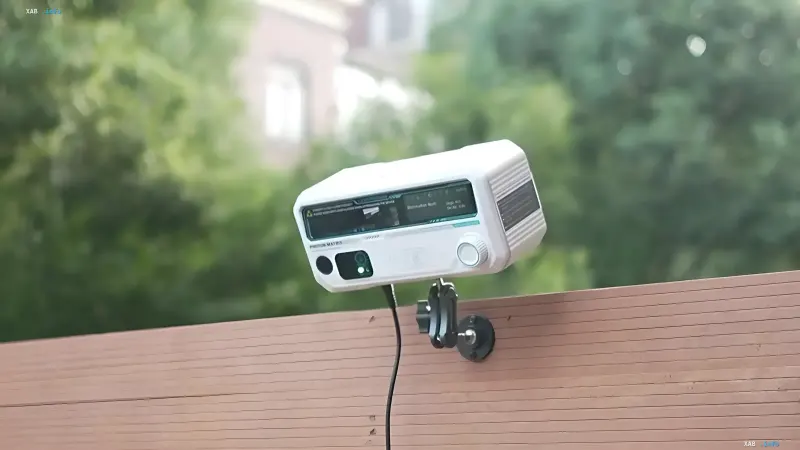
A Chinese startup has introduced the Photon Matrix, an autonomous laser system designed to eliminate mosquitoes in residential and outdoor areas. The device combines lidar, a camera, a millimeter-wave radar, and artificial intelligence algorithms that detect, identify, and target flying insects in real time. According to the developers, the full cycle from target acquisition to firing takes about 3 milliseconds, with the system's throughput reaching up to 30 mosquitoes per second. In the photo, the device is mounted on a wooden outdoor fence, indicating its intended use in domestic environments.
How Photon Matrix Finds and Recognizes Targets
The core of the detection system is a lidar that continuously scans the surrounding space and builds a 3D map of objects. Concurrently, an optical camera and a millimeter-wave radar operate, while software analyzes the size, speed, and movement pattern of every detected object. It is at this stage that AI distinguishes mosquitoes from other flying insects such as flies, butterflies, or small birds. The stated detection range is up to 6 meters, with a horizontal scanning angle of approximately 90 degrees. The system is capable of tracking objects ranging from 2 to 20 millimeters in size moving at speeds up to 1 meter per second.
Targeting Mechanics and Destruction Principle
Once a target is recognized, the algorithm predicts its trajectory and adjusts the firing direction. A key design feature is galvanometer-driven mirrors: they rotate the laser beam while the device itself remains stationary. This allows the beam to be instantly redirected to the next target without the inertia of a mechanical body rotation. A class 4 high-power laser serves as the effector. The pulse is directed straight at the mosquito's wings, damaging their structure and depriving the insect of its ability to stay airborne. Essentially, the system does not "incinerate" the entire target, but rather precisely destroys the flight organs.
Commercial Launch and Pre-orders
The Photon Matrix has successfully completed a crowdfunding campaign and, according to its creators, has already gathered thousands of paid pre-orders. This indicates that the device has moved past the prototype stage and is entering mass production and delivery. Exact shipping timelines and retail prices are not disclosed in the provided materials, but the sheer volume of mass pre-orders signals commercial readiness.
Safety Concerns
A class 4 power laser poses a serious hazard: a direct or reflected beam can cause irreversible damage to the retina of both humans and animals. The developers claim that safety mechanisms are built into the design to prevent accidental exposure to people and pets, alongside restrictions for reflective surfaces that could redirect the beam. Nevertheless, laser safety experts typically recommend mandatory certification and strict zoning of the working area for devices of this class, which has not yet been detailed in the startup's open materials.
Context and Prospects
The Photon Matrix fits into a broader trend of automating domestic tasks using AI and robotics. If the system confirms its claimed performance in real-world conditions—accounting for wind, rain, dust, and the presence of other insects—it could become a mass product for country houses, porches, and open terraces. The main barrier remains regulatory rather than technological: the authorization of class 4 lasers in the consumer segment is restricted in most countries, and certification will determine whether the Photon Matrix appears in markets outside of China.