On November 21, 2026, in Geneva, at the Convention on Certain Conventional Weapons (CCW) conference, 128 states agreed to 'elaborate' a potential document regulating lethal autonomous weapons, known as 'killer robots', over the next two years. The announcement was made on Saturday after nearly 100 countries pushed for the rapid adoption of legally binding rules on armaments capable of killing without human intervention in the final decision to shoot. The final text emerged as a compromise between advocates of a strict ban and key weapons manufacturers who resisted the prompt introduction of mandatory norms.
'Elaborate' rather than 'negotiate': A compromise in wording
According to Swiss diplomat Julien Thöni, who chaired the conference, a number of countries rejected the word 'negotiate', prompting the agreed text to use the term 'elaboration' of a document. Thöni emphasized that more than a decade of talks has led to a significant step in humanitarian disarmament, telling reporters: 'This shows that even in today's deeply fractured world, multilateral diplomacy is capable of delivering concrete results.' He stated that the process must determine which weapons should be banned under international humanitarian law and which can be permitted but subjected to regulation.
Who blocked the talks and how negotiations unfolded
Key arms manufacturers, including the United States, Russia, and Israel, opposed the initiative for the swift adoption of binding rules. Decision-making under the convention requires the consent of all member states, making any compromise difficult. According to diplomats, Russian objections on procedural issues led to the cancellation of several official sessions, while negotiations on the final text continued through the night.
Civil society protest and human rights assessment
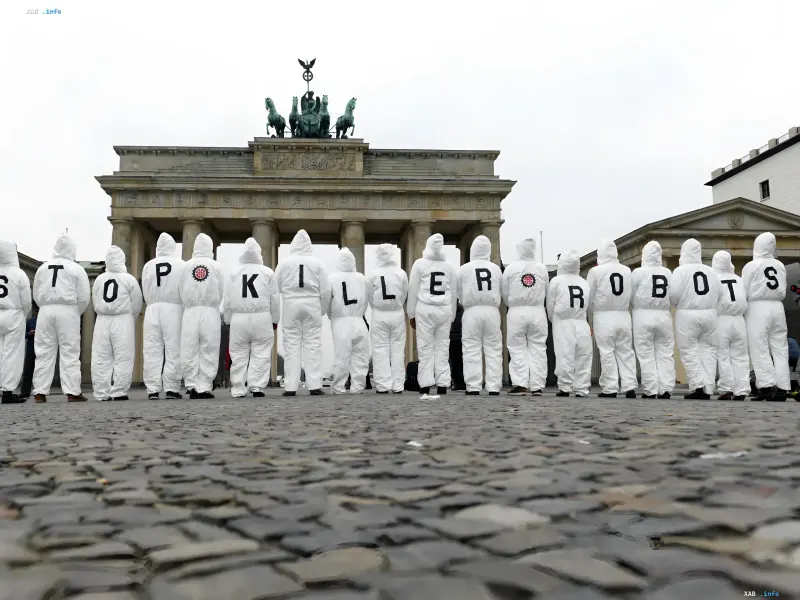
The Stop Killer Robots coalition, uniting 300 organizations opposing the development and use of autonomous weapons, dismissed the resulting mandate as 'watered-down' and argued it provides no clear path to legally binding rules. Coalition Executive Director Nicole van Royen told AFP that autonomous weapons are already being deployed in combat, including systems utilizing artificial intelligence for target selection, adding: 'Delaying a legally binding instrument puts civilians and humanity at risk.' The coalition's actions have been accompanied by public protests: in one demonstration outside the Brandenburg Gate in Berlin, participants wearing white hooded suits bearing the inscription 'STOP KILLER ROBOTS' on their backs lined up in front of the historical monument. Meanwhile, Verity Coyle, senior arms advisor at Human Rights Watch, called the outcome disappointing: 'It fails to deliver the urgent action needed to agree new rules — yet the technology is relentlessly advancing,' she told AFP.
What this means for the future of regulation
The outcome of the Geneva conference establishes a two-year timeframe during which states are to formulate the parameters of a future document, but it does not establish a mandatory ban. In practice, the agreement secures the continuation of the CCW negotiating track and assigns the process the task of distinguishing between prohibited and regulated autonomous weapons systems. For proponents of strict control, this pace is seen as inadequate given the real-world deployment of such systems, while the conference's diplomatic leadership views it as proof that multilateral mechanisms remain functional amidst deep international division.