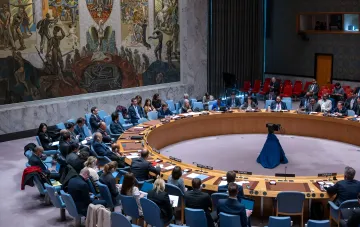
The Russian delegation blocked the start of substantive discussions on restrictions for fully autonomous weapons at the conference of the High Contracting Parties to the UN Convention on Certain Conventional Weapons (CCW) in Geneva. On Monday, November 16, representatives of the Russian Federation raised a number of procedural issues and refused to approve the agenda, after which the conference chair suspended the meeting until the afternoon. Thus, on the very first day of the five-day meeting, the very possibility of reaching a decision on launching negotiations on autonomous weapons was jeopardized.
Guterres's Appeal: Stop 'Merciless Weapons'
Opening the conference, UN Secretary-General António Guterres, in a video message to the 128 CCW states parties, urged the international community to urgently restrict the use of so-called 'killer robots'—fully autonomous lethal weapons systems that independently locate and pursue targets and deliver lethal strikes without human intervention, powered by artificial intelligence. 'Take action to prevent the use and spread of these merciless weapons,' he stated, adding that it is necessary to promote the development of a legally binding instrument regulating autonomous weapon systems and to continue efforts to protect civilians from the suffering caused by armed conflicts.
Moscow's Procedural Maneuver and Accusations Against the EU
Immediately after the UN Secretary-General's opening remarks, the Russian representative took the floor and accused the European Union, whose representatives hold observer status at CCW conferences, of spreading 'politically motivated statements' and false claims at previous meetings. The Russian delegation demanded a decision that observers—contrary to established procedure—should only be allowed to speak at the very end of the conference rather than on individual agenda items. Russia's proposal found no support, but since decisions at such meetings are normally made by consensus, the chair suspended the session until the afternoon.
What It Is Really About: A Mandate, Not a Ban
The goal of the five-day conference is not to adopt a ban, but to decide on the possible initiation of negotiations regarding clear restrictions or a total ban on certain types of autonomous weapons. In other words, only the mandate to hold negotiations is being discussed. The vast majority of participating countries, including Austria, Belgium, and Ireland, support the adoption of a legally binding protocol and intend to demand the start of negotiations to ban 'killer robots'. Germany, together with France and several other states, is promoting a two-track approach: on the one hand, a ban on fully autonomous systems operating outside of any human control, and on the other, the regulation of systems possessing autonomous functions.
The Position of Two Military Powers
Two major military powers—the United States and Russia—oppose the start of negotiations on banning 'killer robots'. At best, according to the epd news agency, they are only willing to continue informal discussions within the framework of the CCW Convention, which impose no obligations and have been ongoing for about 13 years. The blocking of the agenda on the first day of the conference thus reflects the ongoing divide between the majority of countries demanding mandatory regulation and the two powers insisting on maintaining the status quo.