Physicists have experimentally confirmed for the first time the existence of an exotic form of water that behaves fundamentally differently from ordinary ice. This is reported by RBC-Ukraine, citing a study published in the specialized scientific journal Physical Review Letters. The scientists described a new phase of ice in which, under extreme conditions of pressure and temperature, water acquires anomalous properties and transitions into so-called superionic state — a hybrid form of matter that combines the characteristics of a solid and a liquid.
How Physicists "Squeezed" Water Between Diamonds
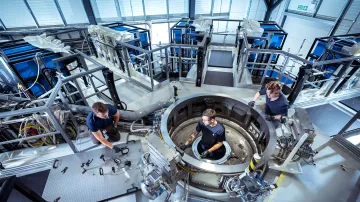
To recreate the conditions that prevail in the interiors of gas giants, the researchers squeezed microscopic droplets of water between the tips of ultra-strong diamonds and simultaneously heated them with lasers. The pressure in the experiment reached 230 gigapascals — about 2.3 million atmospheres; for comparison, the pressure at the center of the Earth is approximately 360 gigapascals. The samples were heated up to 2,357 °C, with temperatures of about 1,427 °C recorded in the initial stages of the phase transitions, and up to 1,977 °C during the formation of the main phases. The structure of the forming ice was analyzed using a narrow beam of X-ray radiation.
A Hybrid of a Solid and a Liquid
Under normal conditions, water evaporates and expands at high temperatures. However, under colossal pressure, such expansion becomes impossible, and the substance transitions into a superionic state. This is a hybrid phase that simultaneously possesses the properties of a solid and a liquid: oxygen ions maintain an ordered crystalline lattice, while protons (hydrogen ions) move freely within it, like particles in a liquid. It is precisely this combination that makes the new form of water anomalous from the standpoint of classical physics.
The Hexagonal Phase Ousts the Cubic One
The key result of the work was the discovery of a new hexagonal modification of ice (hcp). At pressures above 200 gigapascals, it was this hexagonal form that became the main and thermodynamically stable one, displacing the previously known cubic modification (fcc). The scientists also recorded that the new phase begins to transition into the superionic state at a temperature of about 1,427 °C, which is significantly lower than expected for similar transitions in other ice modifications.
What This Means for Uranus and Neptune
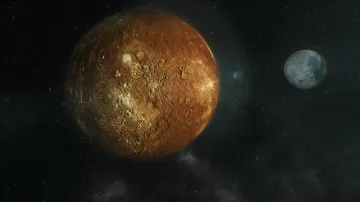
The discovery has direct implications for understanding the internal structure of the ice giants. It is believed that superionic ice makes up a significant part of the interiors of Uranus and Neptune. If the new hexagonal phase conducts electric current and deforms differently than previously known forms of ice, scientists will have to revise the existing models of matter and electric charge movement inside these planets. It is precisely these internal processes that are responsible for the formation of the characteristic asymmetric and chaotic magnetic fields of the ice giants.
What's Next
At present, the authors of the study are calling on theorists to carry out additional calculations to study in detail the electrical and mechanical properties of the newly discovered phase. Only then will it become clear how significantly the new hexagonal modification will change modern understanding of the physics of gas giants and of the behavior of water under extreme conditions that are inaccessible in Earth's laboratories.