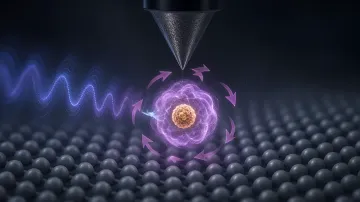
A group of physicists has demonstrated a fundamentally new result in the fields of quantum optics and solid-state physics: for the first time in the history of experimental physics, researchers have directly visualized Landau — Zener — Majorana transitions in monolayer graphene. This refers to a quantum process in which a strong electric field transfers electrons from one energy band to another, breaking the adiabatic regime where a system remains in its initial state under slowly changing external influences. To capture these ultrafast events, the scientists developed a subcycle imaging method capable of tracking changes in electronic structure faster than a single cycle of a light wave oscillation. The experimental results, published in November 2026, clearly show how intense radiation controls the motion of electrons in a material on femtosecond timescales.
Transition Mechanics: From Adiabatic Regime to Interband Tunneling
Landau — Zener — Majorana transitions occur when an electron, driven by a rapidly changing electric field, passes through a region where energy bands converge and tunnels between them. Under normal conditions, with a sufficiently smooth change in external action, the quantum system remains in its initial energy state — this is known as the adiabatic regime. However, a sufficiently strong field can disrupt this regime and induce an electron transition to another band. Graphene, with its characteristic linear energy band structure where the valence and conduction bands meet at Dirac points, serves as an exceptionally clear «laboratory» for studying such processes. This is why monolayer graphene was deliberately chosen as the research object: its band structure makes interband transitions maximally sensitive to an external field.
Experimental Setup: Two Pulses and a Photoemission Microscope
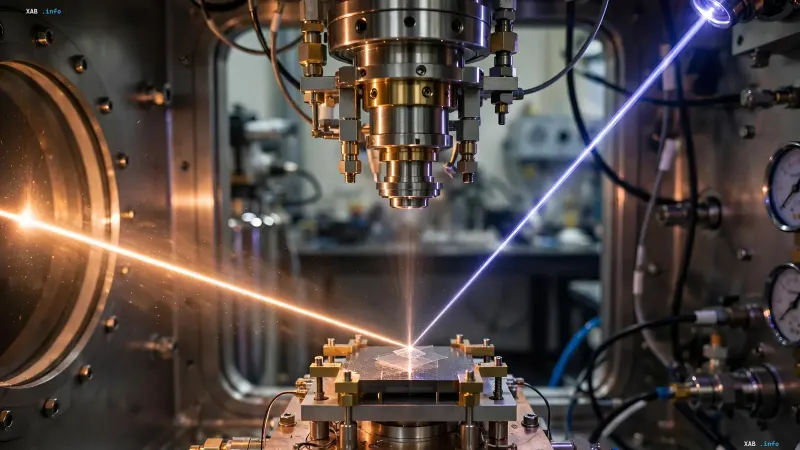
During the experiment, the physicists irradiated monolayer graphene with intense mid-infrared pulses at a frequency of about 30 terahertz. Subsequently, short extreme ultraviolet (XUV) pulses ejected electrons from the material, and a photoemission microscope recorded their energy and momentum. By repeating the measurements with various time delays between the «pump» and «probe» pulses, the researchers obtained a sequence of snapshots showing the electron distribution across energy bands. This allowed them to trace how a strong field simultaneously accelerates electrons within a band and induces interband transitions, creating a sort of «video recording» of quantum dynamics.
Resolution Breakthrough: The Entire Brillouin Zone in 10 Femtoseconds
The main technical achievement of the work is covering the entire first Brillouin zone, which describes the full range of possible electron momenta in the crystal lattice. Previously, subcycle photoemission experiments could only investigate limited areas of momentum space. The new setup expanded the accessible region by more than 100 times, fundamentally changing the scale of observed phenomena. The time resolution achieved was less than 10 femtoseconds — that is 10⁻¹⁵ of a second, during which light travels only about three micrometers. Meanwhile, the timing jitter and delay adjustment precision reached 230 attoseconds, allowing researchers to resolve events occurring faster than a single oscillation cycle of the infrared field.
Two Processes Simultaneously: Acceleration and Interband Transitions
The data obtained showed that under the influence of a strong field, the electron distribution not only shifts in momentum space but also noticeably changes its shape. This indicates the simultaneous action of two physical processes: electron acceleration within an energy band and interband Landau — Zener — Majorana transitions. Comparing the experimental data with quantum-mechanical calculations allowed the researchers to separate the contribution of each mechanism and trace exactly how the electronic distribution changes over the course of several femtoseconds. This approach paves the way for quantitative modeling of ultrafast quantum processes in solids.
Speed Limit: Phonons and 9 Femtoseconds
The scientists also established that coherent control of electrons by a light field is limited by their scattering upon interacting with crystal lattice vibrations, or phonons. Optical phonons play a special role: they rapidly redistribute electrons across momenta and destroy the coherence of their quantum evolution. According to the authors' estimates, the characteristic scattering time is about 9 femtoseconds. This value sets an important temporal limit for future devices where electron motion is intended to be controlled directly by a light wave: if the control pulse is longer than this time, coherence is lost and control becomes inefficient.
Prospects: From Graphene to Other Quantum Materials
The new technique opens up the possibility of studying ultrafast quantum processes not only in graphene but also in other quantum materials. The authors expect to apply it to investigate light-driven bandgap engineering, phase transitions, and electron dynamics in solids. In the future, such measurements will help answer a fundamental question: how quickly electronic states in materials can be switched using light. This is directly relevant to the development of next-generation optoelectronic devices in which light, rather than electric current, will control the electronic properties of materials on attosecond and femtosecond timescales.