Researchers at the Pioneer Labs institute have presented a concept for an autonomous system called Mars Seed, designed to construct pressurized housing on Mars before the crew arrives. According to calculations published on the arXiv preprint server, the system is capable of producing up to 870 square meters of protected space approximately every four Earth years. The concept was developed at Pioneer Labs, a research institute founded by bioengineer Erika DeBenedictis under the open science policy of The Astera Institute. The total mass of the complex is 20 metric tons, and deployment is planned for a flat region in the mid-latitudes of Mars near underground water ice deposits.
A Nuclear Reactor as the Heart of the Biofactory
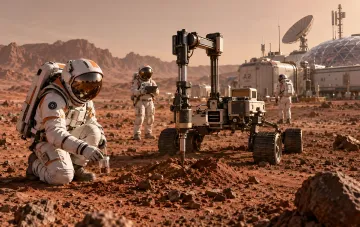
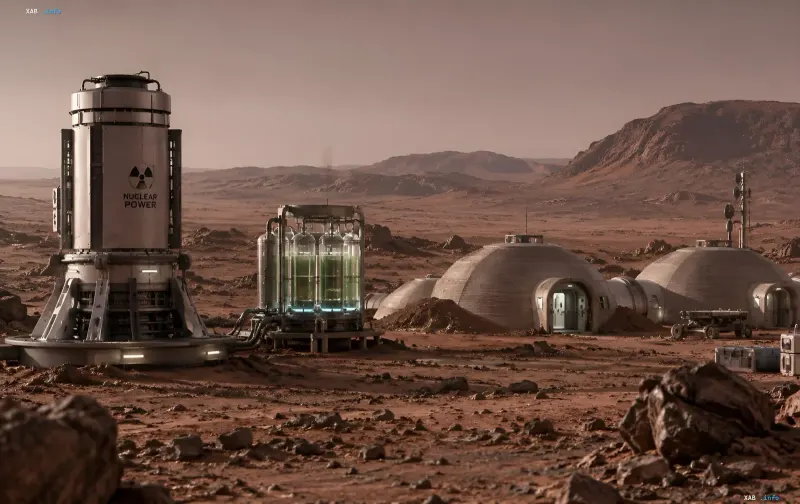
After landing, an autonomous rover unloads the equipment and assembles a 40-kilowatt fission nuclear reactor. According to the designers, the unit is expected to become operational after about a month, providing the complex with electricity and heat. The reactor's heat is channeled into a Rodriguez well to melt underground ice and deliver liquid water to the surface; the system recovers about 90 percent of the water from each production batch. Every day, approximately four metric tons of Martian regolith are loaded into bunkers, from which about 800 kilograms are mixed with water in tanks to extract phosphorus and nitrogen—key elements for biological processes.
Microbes Resistant to Martian Perchlorates
Martian soil contains perchlorates, which are hazardous to most microorganisms, so specialists had to adapt a strain of the bacterium Cupriavidus necator, named sPL.001, capable of surviving in an environment containing these compounds. To provide the microbes with food, the system converts carbon dioxide from the Martian atmosphere into carbon monoxide and oxygen, similar to the MOXIE experiment, and then converts the carbon monoxide along with water into liquid acetic acid. In four fermentation tanks, each with a 1000-liter capacity, the bacteria consume this acid and oxygen, accumulating polyhydroxybutyrate bioplastic, which eventually makes up 70 percent of their cell mass.
3D Printing Housing from Regolith and Bioplastic
Half of the resulting paste is mixed with Martian soil and fed into a large gantry 3D printer to print a ribbed outer shell, which the rovers then cover with approximately two meters of soil for protection against cosmic rays and micrometeorites. The other half is processed in a pressurized liquid carbon dioxide bath to isolate pure bioplastic and mold it into an airtight inner tent, suitable for supporting an atmosphere. Researchers estimate that the system, along with a pair of auxiliary vehicles, will be able to construct approximately 75 square meters of safe shelter every 130 days.
Economics: Break-even in Two Orbital Windows
Compared to shipping 20 metric tons of finished plastic materials from Earth, the break-even point for the autonomous biofactory occurs after approximately 1400 Martian days, which corresponds to two orbital windows before the crew is launched. The developers emphasize that many engineering challenges remain before a real launch; if solved, the technology would allow for the creation of protected bases using the water, soil, and gases of Mars itself, reducing the colony's dependence on supplies from Earth.