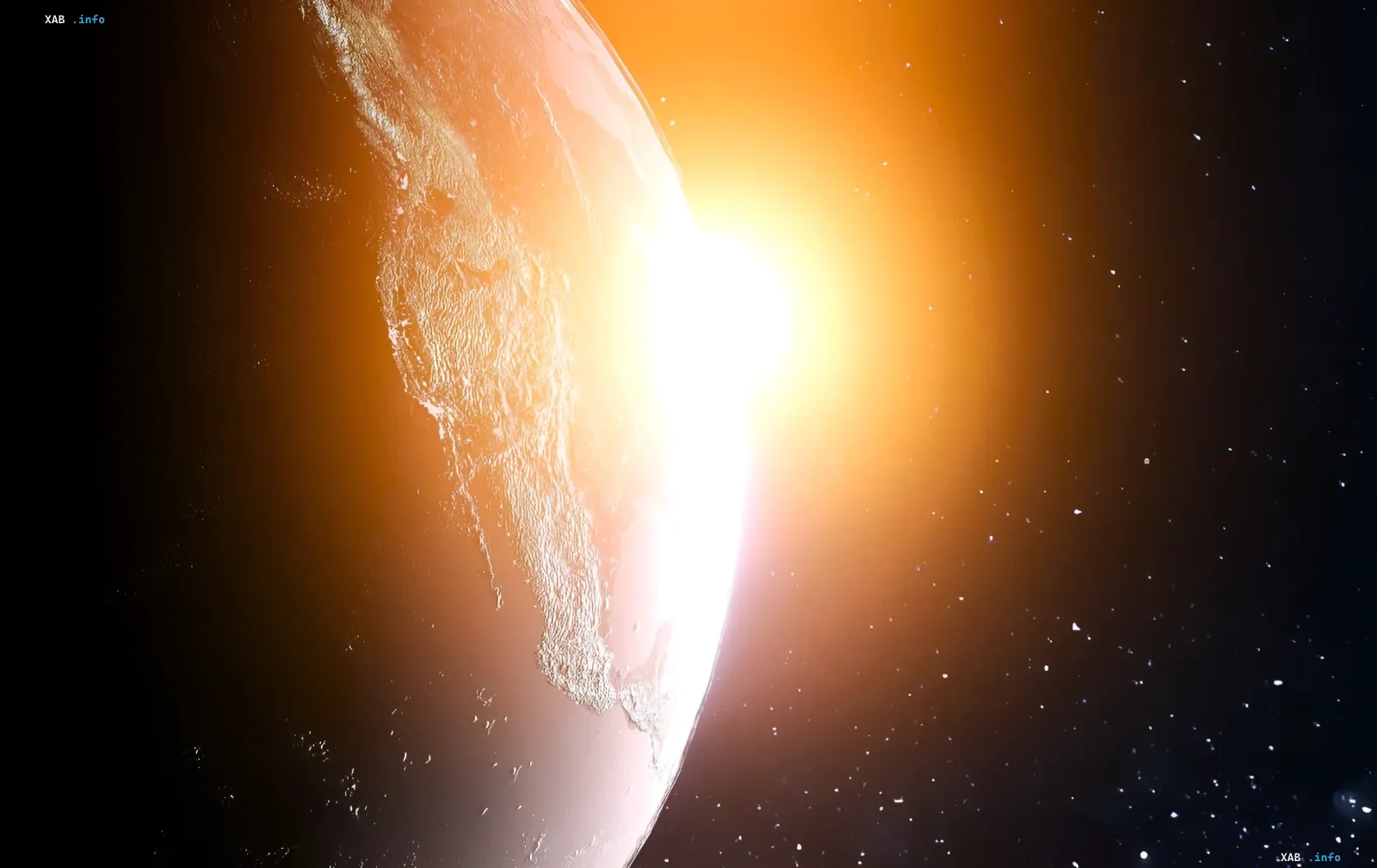
The scientific community is discussing a radical engineering project aimed at keeping Earth habitable in the era when the Sun begins to turn into a red giant. Independent researcher Gabriel Garry published a large-scale plan in the professional journal Journal of the British Interplanetary Society. According to the author's calculations, humanity can prevent the oceans from boiling and the atmosphere from burning out by using a combination of giant space structures and gravitational mechanics.
Giant solar shield
The first and, perhaps, the most complex stage of Garry's plan is the creation of protection against excess radiation. As the Sun burns through its hydrogen fuel, it will expand, which will inevitably lead to the overheating of Earth. To neutralize this factor, the scientist proposes building an artificial shade.
The structure is a shield 700 thousand kilometers wide. The orbit of the Moon has been chosen for its placement. Fixing such a massive object in space is solved using a carbon cable 2 million kilometers long. The cable will be tied to a counterweight located at the Lagrange point L1 (between Earth and the Sun), which will ensure the stability of the system.
From the point of view of materials science, the project looks feasible, although it requires colossal resources:
- The thickness of the structure will be only 0.1 millimeters.
- The material will be aluminum with a total mass of about 100 billion tons.
- To extract aluminum, only 0.01% of the Moon's mass will need to be extracted.
- The cable will be made from materials of the dwarf planet Ceres.
Jupiter as a source of energy and fuel
Complete blockage of sunlight, necessary to save the planet from overheating, will lead to the loss of natural heat and light. To solve this problem, Garry proposes using Jupiter's resources.
Thermonuclear reactors using hydrogen and helium-4 will be placed in the giant's atmosphere. The energy generated by these reactors will be transmitted to Earth using powerful lasers through a relay system. Thus, humanity will receive artificial sunlight to compensate for the planet's shading by the shield.
Moving Earth: gravitational "slingshot"
Even with protection from radiation, Earth risks being physically absorbed by the expanding Sun. To avoid this, the planet must be moved from its current orbit (1 astronomical unit) to a safe distance of 1.2 a.u.
To implement this maneuver, Garry proposes using the principle of a jet engine. Oxygen will be extracted from Jupiter's atmosphere and delivered to Earth's orbit. A station at Lagrange point L2 (located behind Earth) will intercept this flow and launch it beyond the orbit. The effect of the gravitational "slingshot" will allow the Earth's orbit to be safely accelerated and the distance to the star increased.
Additional threats and calculations
In addition to the direct threat from the Sun, the author of the study provides detailed calculations to neutralize other global risks that may arise in the future. The plan includes scenarios for protection from the cessation of plate tectonics, loss of water resources, and collisions with space objects.
Contradictory data
It is important to note that this plan is a theoretical study. Although it is published in an authoritative scientific journal, there is currently no confirmed data on the practical implementation of such technologies in the foreseeable future. Gabriel Garry's project is viewed more as a conceptual model of an engineering solution to the problem of the end of the Solar System's life than as a ready-made program of action.