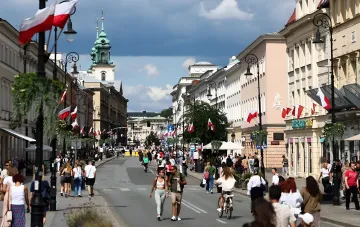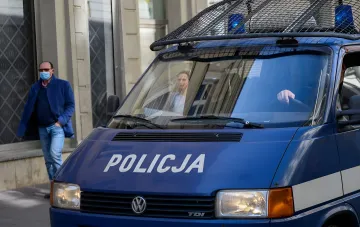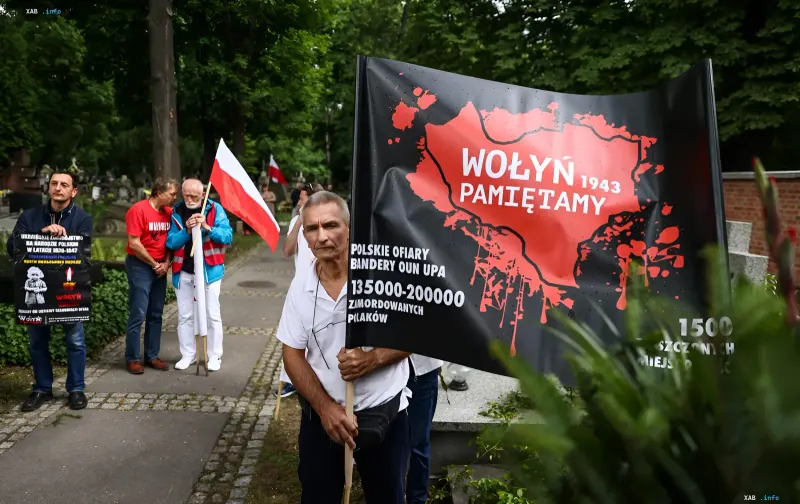
In Poland, hostility toward the roughly 1.5 million Ukrainians living in the country is increasingly turning into direct street attacks, while right-wing radical politicians, in the assessment of journalists, are only feeding this hostility with their rhetoric ahead of the 2027 parliamentary elections. RBC-Ukraine reports this, citing Politico. Against this backdrop, memorial actions are taking place in Polish cities, where, as seen in the photo, participants carry placards bearing the inscription «WOŁYŃ 1943 PAMIĘTAMY» («Volhynia 1943, we remember») and the figures of the victims, which underscores that the historical trauma surrounding the events of 1943 remains one of the main triggers of tension between the two societies.
Political backdrop: the 2027 elections and the «language of hatred»
According to Politico, Polish nationalists are turning the attitude toward the Ukrainian minority into a full-fledged political issue ahead of the 2027 parliamentary elections. A key trigger for the escalation was the decision by Polish President Karol Nawrocki to strip Ukrainian President Volodymyr Zelensky of the highest state decoration — the Order of the White Eagle — over the decision to name a military unit after the Ukrainian Insurgent Army. The libertarian party «Confederation» publicly condemned the receipt of social assistance by Ukrainians, while Member of the European Parliament Grzegorz Braun stated: «The Kyiv regime is neither our ally nor our friend, it is our enemy». Professor of sociology Rafał Panekowski notes that it is precisely this populist rhetoric that turned the Ukrainian minority into a target and contributed to verbal animosity escalating into physical violence.
Figures: statistics on ethnically motivated crimes
Quantitative data confirm the worrying trend. According to a CBOS survey, the level of Poles' antipathy toward Ukrainians rose from 38 to 43 percent in just the last year. Polish police recorded 180 reports of ethnically motivated crimes against Ukrainians in the first half of the year — 30 percent more than a year earlier. Meanwhile, between February and June, Polish prosecutors sent 283 cases to court, and Ukrainians were the victims in more than 80 percent of them — compared with 4 percent in 2014. These figures show that Ukrainians have turned from «guests» into the main group of victims of ethnically motivated violence in the country.
Incidents: from Kozuchowo to Radom
Specific episodes illustrate how rhetoric turns into action. On August 1, in the Polish town of Kozuchowo, unknown assailants attacked three Ukrainians who were resting near their car in the evening: a conflict broke out over music, the attacker shouted «get back to Ukraine», and then returned with a group of men, after which a brawl ensued. On August 2, in Radom, eight men brutally beat up three young Ukrainians, to whom a drunk Pole had first wanted to «deliver a lecture on Volhynia»; the police detained the organizer of the attack, who faces up to five years in prison. A separate case was described by Ivan, who works at the University of Warsaw: his neighbor began shouting at him over Zelensky's decision to name the military unit and demanded that he «go back to Ukraine», after which, according to Ivan, he fears that «no one will help and they will simply deport him».
Contradictory data
Around the historical context — the events in Volhynia in 1943 — the positions of the two sides diverge significantly, and this is important to take into account when interpreting what is happening. The Polish nationalist side, including at memorial actions and in publications such as Myśl Polska, emphasizes the role of the OUN and UPA in the genocide of the Polish population, citing figures in the range of 135,000 to 200,000 killed Poles (as on the placard «135000-200000 ZAMORDOWANYCH POLAKÓW») and accusing the Ukrainian side of attempting to «justify the genocide of Poles». The Ukrainian side, and some analysts, conversely, point out that these events are being used as a political tool to legitimize the current hostility toward Ukrainians in Poland, while the figures of the victims and their attribution remain a subject of historical dispute. Moreover, in the statistics it is important to distinguish two different indicators: the 180 reports are police data on complaints received in the first half of the year, while the 283 cases are the number of cases sent by prosecutors to court between February and June; this is not a contradiction but different cross-sections of the same process, although their mixing in public discourse can distort the picture.
Authorities' reaction and the deportation problem
Polish Prime Minister Donald Tusk stated that the attackers have become bolder because they feel politically protected, and called on President Nawrocki to «finally react»: «We must resolutely fight this violence, because this violent pathology has become bold, since it has received political patronage». However, in practice, according to reports, Polish authorities deport Ukrainians even for minor offenses — for example, one 18-year-old Ukrainian was expelled from the country for jumping over a barrier at a concert. Thus, the combination of populist rhetoric, the rise in ethnically motivated violence, and strict migration practice is creating in Poland an environment in which the Ukrainian minority feels simultaneously like a political scapegoat and a vulnerable group on the streets of the country.