On the night of 24 September 2026, Poland took emergency security measures on its eastern border, evacuating people from two border crossings — 'Dorohusk' and 'Zosin'. This was announced by Polish Prime Minister Donald Tusk, speaking after a nighttime Russian missile and drone strike on Ukraine that landed directly near the Polish state border. According to RBC-Ukraine, citing Polish radio RFM24, the evacuation was carried out under an emergency protocol due to the immediate security threat in the border zone.
Evacuation of border checkpoints: timeline and reasons
The decision to evacuate civilians from the 'Dorohusk' and 'Zosin' border crossings was made by Polish authorities in response to Russia's nighttime attack on Ukrainian territory. Both checkpoints are located in the Podlaskie Voivodeship and are among the key land crossings between Poland and Ukraine. Tusk emphasized that the enemy attack occurred at the very moment he was holding international negotiations in Warsaw. 'It is not the first time that while I am talking in Warsaw with our partners about Russia's aggressive actions and what a problem this is for Poland — at that very moment the Russians confirm it. Just as we were talking, Ukraine was again attacked near the Polish border,' the Polish prime minister stated. The evacuation, he said, was a consequence of the immediate threat arising from the fall of debris or the deviation of munitions' trajectories in the border zone.
Context of the nighttime strike: 'Zircon', ballistic missiles, and 282 drones
The nighttime strike on Ukraine, which triggered Poland's security measures, was one of the largest in recent times. According to available data, the aggressor state employed 'Zircon' anti-ship missiles, ballistic missiles, and 282 strike drones. Ukraine's air defense forces destroyed 227 aerial targets, however, some munitions still reached their designated targets in the Odesa and Kyiv regions. It was the strikes in the Kyiv region, located in immediate proximity to the Polish border, that created the conditions for the emergency evacuation at the 'Dorohusk' and 'Zosin' checkpoints.
Casualties and aftermath in Kyiv
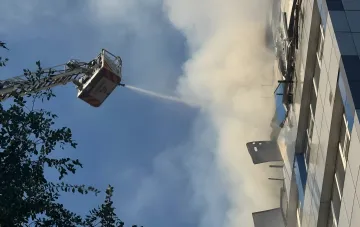
As a result of the nighttime strike on Ukraine's capital, two people were killed and at least eight were injured. In the Dniprovskyi district of Kyiv, State Emergency Service rescuers freed a person from under the rubble of a destroyed residential building. The scale of the destruction and the presence of fatalities confirm that the nighttime attack was a deliberate strike on civilian infrastructure and residential areas, not exclusively on military targets.
Tusk's warning: 'Autumn and winter may turn out to be critical'
The Polish prime minister used the address to send a clear signal to both the domestic political establishment and European partners. Tusk stated that such situations compel Poland to act 'very consistently' on its own territory, deepen cooperation with Ukraine, and warn the European Union of the onset of 'difficult times'. 'We must prepare well for the coming weeks and months. Autumn and winter may turn out to be truly critical,' he warned. This statement can be regarded as a preparation of public opinion for a possible escalation of the conflict in the autumn-winter period, when, according to expert assessments, Russia traditionally intensifies strikes on Ukraine's energy infrastructure.
Geopolitical context and the EU's reaction
The evacuation of the border checkpoints — although local and temporary — carries symbolic significance: it confirms that Poland's border zone is increasingly falling within the zone of immediate risk during strikes on Ukraine. For Brussels, this is yet another argument in favor of accelerating the delivery of air defense systems and strengthening NATO's eastern flank. For Warsaw — a confirmation of the need to maintain an elevated level of readiness among border and military structures. Tusk's statement about the need to 'prepare well' for winter sounds like a direct indication that Poland does not rule out a scenario in which the intensity of Russian strikes on Ukraine's border regions will only grow as the cold approaches.