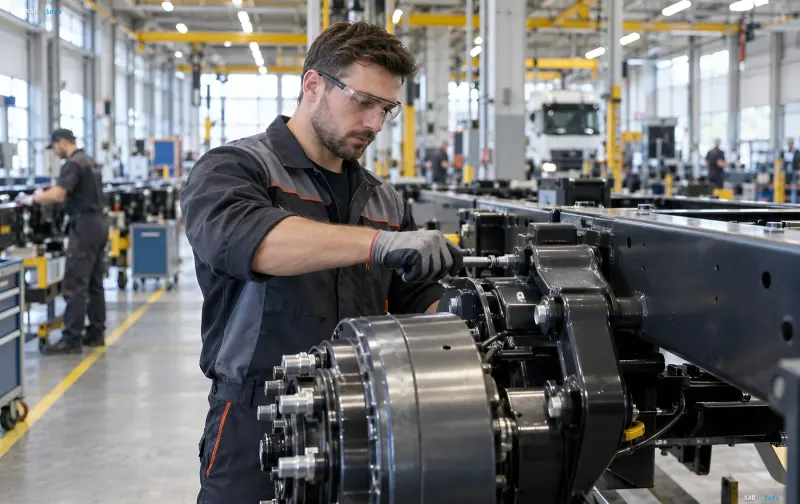
In the third quarter of 2026, Poland's labor market is undergoing a pronounced structural restructuring: labor demand is concentrating in specific sectors, while others continue to downsize their staff. The Gremi Personal analytical center, relying on data from the National Bank of Poland (NBP), the Central Statistical Office (GUS), and industry monitoring, recorded that employment is growing most dynamically in the production of transport equipment, industrial machinery, and electronics. At the same time, the automotive industry, light industry, and furniture manufacturing are losing workers. Employers are covering part of the personnel deficit with foreign specialists, a significant share of whom are Ukrainians, but companies' overall approach to personnel costs remains restrained.
Defense and Infrastructure Momentum
The leader in employment growth among industrial sectors was the production of transport equipment: in the third quarter of 2026, the number of workers in the sector increased by 2.8% year-on-year to 60,300 people. This block includes enterprises manufacturing military equipment, railway rolling stock, ships, and aviation equipment. Gremi Personal analysts attribute the additional momentum to government orders and investments in defense and infrastructure. In parallel, the number of employees in the production of industrial, infrastructural, and specialized equipment increased by 2.4% to 126,000 people, while in the computer, consumer electronics, and optical equipment segment, growth reached 3.9%.
Sectors Where Staff is Shrinking
At the opposite pole is furniture manufacturing, where employment decreased by 6.3% year-on-year to 75,000 workers. Light industry lost 5.5% of its personnel down to 136,300 people, and the automotive industry dropped by 3.3% to 194,700. Analysts cite falling sales of passenger cars and intensified competition from Chinese home appliance manufacturers among the reasons. Overall, average monthly employment in the manufacturing industry in the third quarter decreased by 1.2% year-on-year—by 29,000 people. Nevertheless, demand for workers remains in the services sector: retail trade added 0.7%, the hotel and restaurant business (HoReCa) grew by 1.4%, and logistics also demonstrates steady demand for personnel.
Wages Grow Slower Than Inflation
Despite employment growth in certain sectors, Polish employers are in no hurry to increase remuneration. According to an NBP survey, the share of enterprises planning to raise wages in the next quarter decreased from 28.1% in the second quarter to 25.7% in the third. The average salary in the business sector in the third quarter amounted to PLN 9,345 gross, which is 6.1% (PLN 537) higher than a year earlier. Meanwhile, annual inflation in September accelerated to 4.1% compared to 2.1% in February. The gap between price growth and wage dynamics forces companies to tightly control the payroll budget and focus on retaining key specialists rather than mass increases.
Forecast: Stabilization Without Mass Hiring
According to Gremi Personal's assessment, until the end of 2026, overall employment in Poland will continue to stabilize, but analysts do not expect mass staff expansions. Labor demand will continue to be unevenly distributed among industries: defense and infrastructure sectors, logistics, and services will continue to attract personnel, while traditional manufacturing industries focused on the consumer market will maintain a downward trend. For foreign workers, including Ukrainians, this means that employment opportunities remain, but are increasingly concentrated in specific sectors and regions experiencing labor shortages.