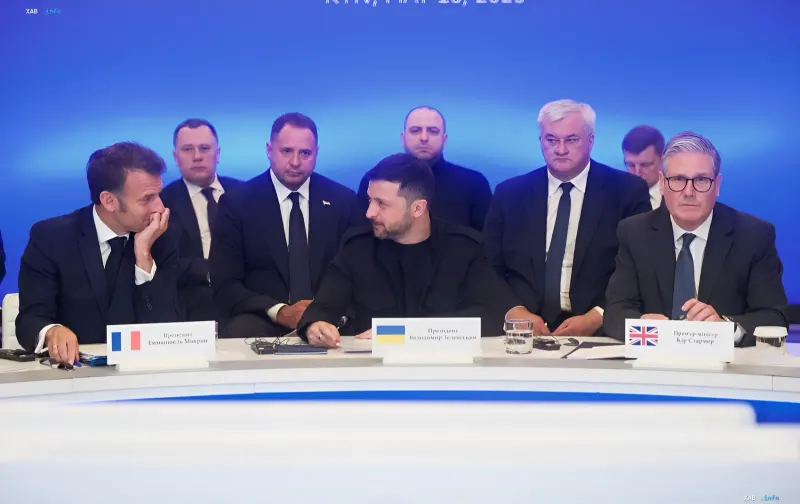
The European security architecture, built around support for Ukraine, is on the verge of a critical turning point. Diplomats and analysts warn that the continent risks losing two of the main architects of this strategy. British Prime Minister Keir Starmer has already left office, and French President Emmanuel Macron will not be able to run for another term. Their departure opens up dangerous uncertainty for the future of Kyiv and the entire Western alliance.
The French Choice: Risk of a Course Change
The main concern of the diplomatic community is focused on the upcoming elections in France. Macron must leave office next year, and there is no obvious successor on the horizon ready to continue his course. Bookmakers and political scientists name the leader of the far-right, Marine Le Pen, as the favorite. She has openly promised to withdraw France from NATO's military command, lift sanctions against Russia, and force Ukraine to agree to peace on Moscow's terms.
Her rival from the left, Jean-Luc Mélenchon, proposes radical measures, promising a complete withdrawal of the country from the Western alliance. British officials, according to a source in The Telegraph, are already studying scenarios in which the victory of one of these candidates could destroy the coalition and the exchange of secret intelligence. A Western diplomat directly warned of a "big problem" for NATO in such a case.
The German Dilemma: Who Will Replace Macron?
The only obvious candidate capable of replacing the French leader in tandem with Britain seemed to be German Chancellor Friedrich Merz. He is actively reforming the Bundeswehr, striving to turn it into the largest army in Europe. However, Merz himself is stuck in an internal crisis, and doubts about his ability to remain in office are growing.
Criticism has come even from within his party. CDU deputy Roderich Kiesewetter, a former colonel, called the party leader "not a Churchill." According to him, both the CDU and the Social Democrats are vulnerable to the so-called "Moscow connection" — a part of the members of the ruling parties ready to return to familiar relations with Russia after the end of the war.
Kiesewetter links this "connection" to specific actions by the Chancellor: withholding Taurus long-range missiles and refusing to confiscate the ships of Russia's "shadow fleet." Merz also thwarted EU attempts to ban the free movement of Russian diplomats in the Schengen zone and refused to close the Berlin "Russian House," which is considered a cover for Moscow's spy network.
"Merz must also fight this Moscow connection," the deputy stated. "This is not leadership. Who then can lead Europe? We need a Churchill. We have had several 'Churchillian moments,' but we do not yet have our own Churchill in Europe".
In Search of a New Leader
The leadership vacuum cannot be filled by other key players either. Poland and Italy, whose leaders are Donald Tusk and Giorgia Meloni, have refused to send troops to Ukraine. In addition, both leaders have elections before the end of next year, which does not allow them to claim the role of new security guarantors.
On the British side, the situation looks slightly more stable. Starmer's successor, Andy Burnham, has a firm grip on domestic politics, although he is limited in foreign policy experience. His first meeting with a foreign leader in his new position was with Volodymyr Zelenskyy in Portsmouth, signaling to allies that the course of supporting Ukraine and NATO will remain unchanged.
The Legacy of the "Coalition of the Willing"
The tandem of Starmer and Macron once overcame years of disputes between London and Paris, uniting more than 30 countries around support for Ukraine and a plan to de-mine the Strait of Hormuz. If Starmer's departure was accompanied by recognition of his merits, Macron's exit will likely be perceived much more anxiously.
However, hope remains for the "coalition of the willing." This structure has repeatedly become a platform for specific defense initiatives. In July, Ukraine, together with nine European countries, created an anti-ballistic coalition to strengthen air defense. Participants in the "coalition of the willing" were also preparing a significant strengthening of Ukraine's air defense, having a concrete action plan at hand.
The future depends on whether Burnham will be able to take on the role of leader of this coalition while Europe searches for its new "Churchill".