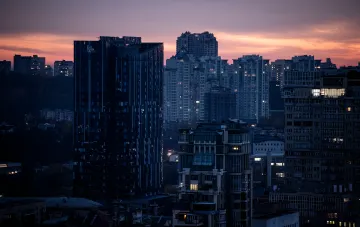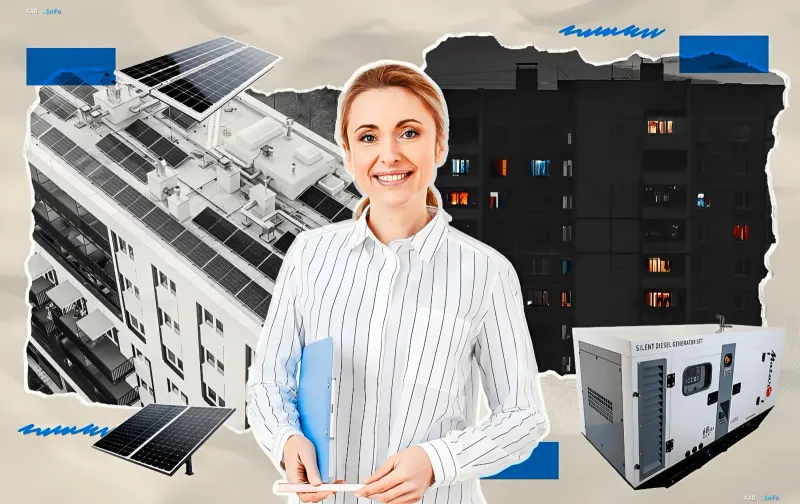
Extended winter power outages can block elevator operations and leave high-rise buildings without water and heating. To protect utility networks, co-owners must combine generators, batteries, and subsidized co-financing programs. The main winter challenge for most Ukrainian high-rises remains long-lasting blackouts. While a separate charging station in an apartment can power a laptop or router, it cannot pump water to the 15th-25th floors, start basement circulation pumps, or heat rooftop boiler houses.
Vulnerability of High-Rise Infrastructure
Most urban residents depend on centralized systems: according to a 2025 Gradus Research study commissioned by the Ukrainian Developers Association, 88% of Kyiv residents live in apartment buildings. At the same time, 85% of respondents seek to improve their living conditions, with 50% pointing to worn-out utilities and 28% to poor technical condition of the buildings themselves. In such conditions, the threat of prolonged blackouts turns building preparation into an infrastructure survival issue. Therefore, co-owners must proactively identify vulnerable engineering nodes and determine what equipment can actually keep them operational.
Areas of Responsibility and Technical Challenges
The primary technical danger of winter blackouts in high-rises is the stoppage of water and heat circulation. However, residents must understand the distribution of responsibilities. As public utilities and infrastructure expert Oleg Garnik explains in a commentary to RBC-Ukraine, heat supply companies are legally responsible for energy delivery only up to the distribution point or commercial metering unit at the building entrance. Everything beyond that within the building's networks is the co-owners' responsibility. Consequently, if house pumps fail to push heat or water upward due to a power outage, the city is not obliged to solve the problem.
HOA Practical Experience and Elevator Systems
Therefore, pump groups, individual heating unit (IHU) automation, and boilers become top-priority objects for backup power. However, ensuring their uninterrupted operation is much harder than it seems. As Elena Svarichevskaya, head of the "Syretsky Boyar" HOA board, notes, they initially thought inverters would be best, but a 27-story building required a robust 136 kVA generator combined with an inverter system. Regarding elevators, Igor Tkachenko, CEO of Euroformat Group, points out that automatic evacuation systems do not support normal elevator operations for hours; they perform a single short emergency cycle to bring the cabin to the nearest floor and open doors.
Contradictory Data
Discussions continue among experts regarding optimal backup power schemes for high-rise buildings. Some specialists insist exclusively on high-capacity battery banks combined with solar panels due to their environmental friendliness and silence. At the same time, the practical experience of HOA heads shows that during deep winter blackouts, doing without powerful fuel generators is virtually impossible due to the immense energy consumption of pumps and boilers. The exact balance between fuel costs, generator noise, and battery capacity remains a subject of sharp debate among residents.