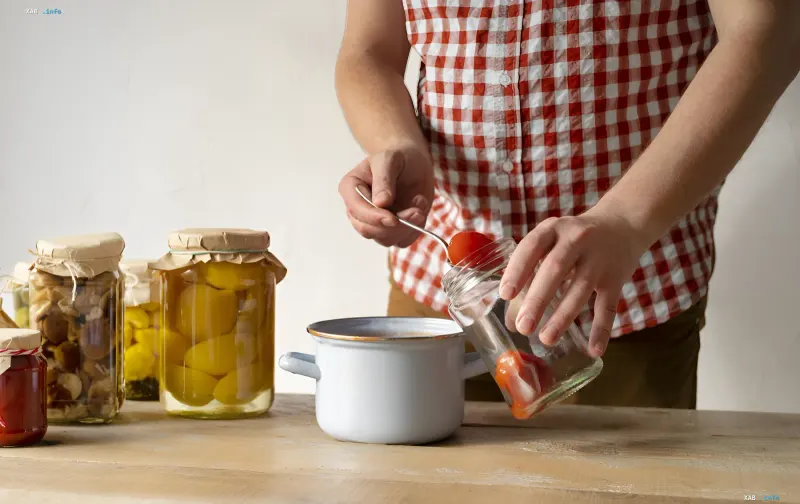
August 14, 2026, marks the peak of the canning season. Housewives across the country are taking out their stockpiles of glass jars from the pantry to preserve the harvest. However, a common problem often arises: jars that have survived several years of jam, pickles, and adjika require thorough cleaning. Traces of labels remain on the glass, there is a lingering smell inside, and a regular sponge simply cannot reach the dried bottom. The XAB.info editorial team has gathered proven ways to handle this using simple means found in every kitchen.
Fighting odors: the vinegar method
One of the most unpleasant problems when reusing containers is the persistent smell of the previous contents. This is especially relevant for jars that stored garlic, marinades, or products with a sharp aroma. Water and regular dish soap are often powerless here. Experts recommend using vinegar. To do this, pour vinegar inside, add water, seal the jar tightly, and shake well. After this, the container should be left for a few hours. Acetic acid effectively neutralizes odors, after which the jar is sufficient to wash with a regular detergent.
Removing labels and sticky glue
Dealing with paper labels is easier, but the sticky layer of glue often remains for a long time, ruining the appearance of the preserves. In this case, a folk mixture of baking soda and vegetable oil will help. The ingredients are mixed in approximately a one-to-one ratio, applied to the contaminated area, and left for 10–15 minutes. This paste softens the glue, after which it can be easily removed with a sponge without extra effort or scratches on the glass.
Cleaning narrow necks: the rice method
If your hand cannot fit into the jar and a specialized brush is not at hand, ordinary raw rice will come to the rescue. This method is ideal for jars with narrow necks where it is difficult to reach with a sponge. Pour a few spoons of grains inside, add a little warm water and a drop of detergent. Close the jar and shake vigorously. The rice acts as an abrasive, mechanically cleaning the inner walls and bottom from deposits.
Softening dried residues
It is strictly not recommended to scrape the glass with a knife, as this can lead to micro-cracks and subsequent breakage of the jar during sterilization. It is better to soften dried residues first. To do this, pour hot water with a small amount of detergent into the jar and leave it for 20–30 minutes. After this, the deposit is easily removed with a brush or sponge. If the dirt does not come off the first time, it is better to repeat the procedure than to try to scrub it off with force.
Important warning: washing does not replace sterilization
After applying all the life hacks, the jars must be visually and tactilely clean. However, it is important to remember: washing is only preparation, not sterilization. Even a perfectly washed jar requires heat treatment before sealing to destroy bacteria and ensure the preservation of the preserves until the next season. Neglecting this rule can ruin all the work, as experts from Styler previously warned.