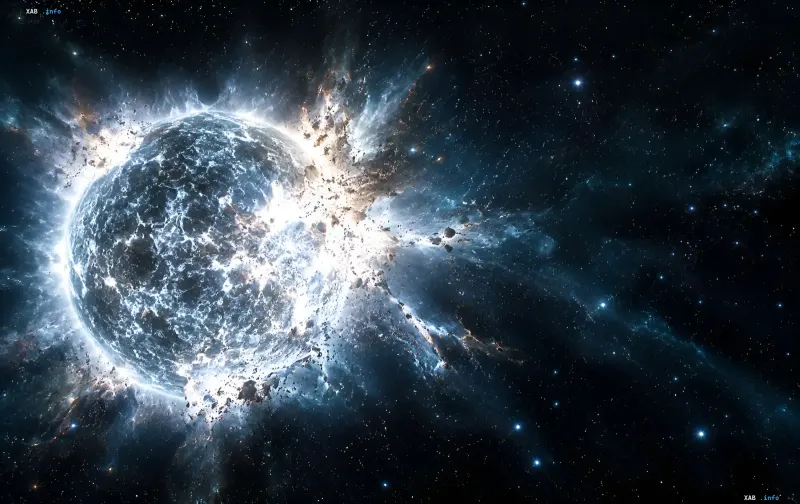
A new study published in the scientific journal The Astrophysical Journal proposes an unexpected way to search for dark matter — through the traces that primordial black holes might leave when interacting with stars. According to RBC-Ukraine, a team of physicists led by Ore Gottlieb from the Massachusetts Institute of Technology (MIT) has simulated a scenario in which a tiny black hole enters a sun-like star and ultimately destroys it from within. If such objects truly exist in the Universe, their "explosive" signatures could be recognized using telescopes.
What are primordial black holes and why are they sought?
Scientists suggest that primordial, or original, black holes could have arisen in the first moments after the Big Bang due to quantum fluctuations — tiny oscillations of energy and matter. Unlike stellar black holes, which are formed by the collapse of massive stars, such objects do not have to be large: researchers estimate their size can vary from an atom to a small grain of sand, and their mass from an asteroid to the Moon. This hypothetical population could potentially account for a portion of dark matter — an invisible substance whose presence astronomers detect only through its gravitational influence on the Universe, but which has not yet been directly detected.
Why they cannot be seen directly
The main problem is that primordial black holes are too small to be observed directly; they do not emit light and do not leave an obvious optical trail. Therefore, Gottlieb and his colleagues took a different path: they modeled what would happen if such a black hole were inside a star. In their model, the process begins with the tiny object sinking into the star's center and starting to consume its gas. This stage alone can take several million years, and subsequent events, as calculations have shown, depend critically on the star's rotation speed.
Two scenarios: slow and fast rotation
If a star rotates slowly or moderately, the black hole continues to consume its matter until the star exhausts its fuel and fades — in this case, no noticeable explosion occurs. The situation is quite different with fast rotation: gas begins to accumulate in a disk around the black hole, and in a matter of seconds, the magnetic field of this disk generates powerful streams of matter and two plasma jets that literally tear the star apart. According to Gottlieb, in this scenario, the black hole acts as a parasite inside the star and eventually triggers its explosion — an event that can theoretically be recorded.
Significance for dark matter research
It was previously believed that the absorption of a star by a primordial black hole would not lead to an explosion and would not leave a noticeable signal, which is why such events remained practically invisible. New work changes this picture: researchers suggest that if such interactions truly occur in the Universe, they can be detected by their characteristic traces. Currently, Gottlieb's team is working to determine exactly what these explosions will look like and how they will differ from other stellar explosions. This will allow verifying whether primordial black holes exist and whether they could be a credible part of dark matter — and thereby, perhaps, bring science closer to solving one of the main mysteries of the cosmos.