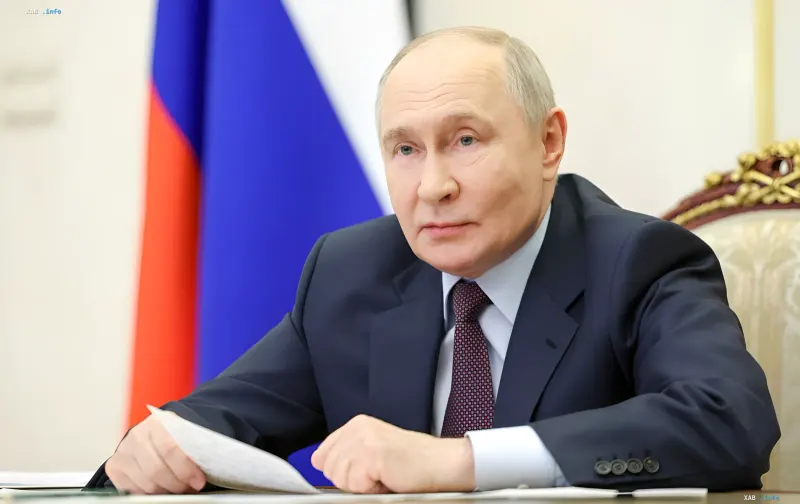
In an interview with Russian propagandist Pavel Zarubin, Vladimir Putin stated that Moscow is "always ready for dialogue" with Ukraine, but exclusively "on the basis of the realities unfolding on the ground." According to him, the proposals being conveyed to the Kremlin "sometimes carry an exotic character" and are unacceptable. The statement came against the backdrop of ongoing attempts by Kyiv to initiate various formats of ceasefire, which Moscow has consistently rejected.
"Exotic" proposals and refusal to give details
When the journalist asked for clarification on which specific initiatives he had in mind, Putin declined to go into details. "I would not like to talk about this now or delve into the details, because this is a kind of probing in various directions of possible agreements. They have sounded one way or another before, but now, in this situation, they are being presented in their own way," he said, adding that "it is premature to get ahead of things and talk about what could form the basis of possible agreements." As a result, the specific list of initiatives deemed unacceptable by Moscow has not been publicly disclosed.
Context: which initiatives reach the Kremlin
Ukrainian President Volodymyr Zelenskyy has repeatedly publicly proposed that Russia cease shelling along the front line. The Kremlin, however, regularly rejects this idea, insisting on the withdrawal of the Armed Forces of Ukraine from Donbas and periodically hinting at the need to withdraw troops from Kherson and Zaporizhzhia regions as well. In July 2026, media reports emerged that Ukraine and the United States had discussed a "cease in the air" option — a halt to mutual missile and drone strikes. The Kremlin then stated that it was "premature" to comment on such publications. Weeks later, the Ukrainian side conveyed to Moscow a proposal to cease attacks on civilian targets in the Black Sea; as of now, no public response from Russia has been recorded.
Contradictory data
There is a significant gap in how the two sides characterize the same initiatives. From the perspective of Kyiv and its partners, proposals for a local ceasefire, a "cease in the air," or the protection of civilian objects in the Black Sea are standard diplomatic steps aimed at reducing the intensity of hostilities. Putin, however, describes them as "exotic" and "unacceptable," without revealing which specific points he considers as such. Moreover, the phrase "realities on the ground" in Kremlin rhetoric is consistently interpreted as an acknowledgment of the occupied territories as part of Russia, whereas the Ukrainian side insists on restoring the 1991 borders. Thus, both sides use the term "dialogue" while implying fundamentally different starting positions, which makes the actual compatibility of their demands at the current stage extremely low.
Assessment of prospects
Putin's statement, made in the format of an interview with a propagandist channel, more likely serves the function of internal mobilization and signaling to a Western audience than reflects a readiness for concrete negotiations. The absence of a public Moscow response to Ukrainian initiatives on a "cease in the air" and Black Sea protection, as well as the refusal to discuss the details of the "exotic" proposals, indicate that the Kremlin does not consider the current moment suitable for moving to formal negotiation tracks. At the same time, the formula "we are always ready for dialogue" is retained as a rhetorical tool that allows shifting the responsibility for the absence of negotiations onto the side whose conditions "do not correspond to the realities."