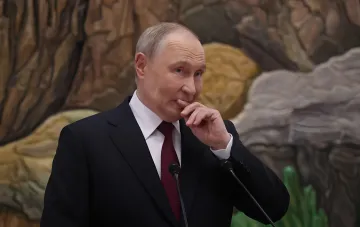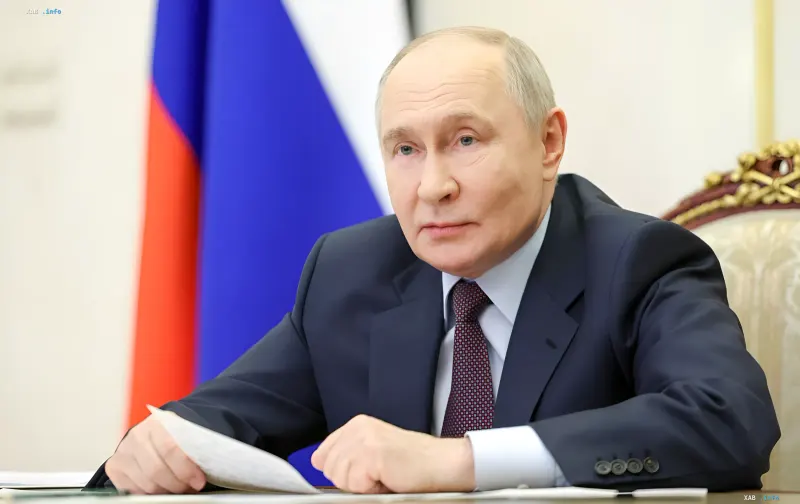
Vladimir Putin stated that Russia is ready for dialogue on ending the conflict with Ukraine, but exclusively “on the basis of the realities unfolding on the ground.” According to RBC-Ukraine, he said this in an interview with Russian journalist Pavel Zarubin, released against the backdrop of ongoing attempts by the parties to discuss the parameters of a possible settlement. In Putin's words, the proposals currently being put forward to Moscow “are at times of an exotic nature” and are unacceptable, while he emphasized that “we are always ready for dialogue,” but only taking into account the factual situation on the front line.
The condition of “realities on the ground”
The key element of the Russian leader's statement was the formulation about “realities on the ground.” In the Kremlin's public rhetoric, this phrase traditionally means that any negotiations must be conducted taking into account the current control over territories, rather than referring to the borders prior to the start of active hostilities. Thus, Moscow effectively entrenches a position in which the initial conditions for dialogue are determined by the front line and the positions held, rather than by demands to restore the previous status quo. This directly echoes the Kremlin's earlier statements that the Ukrainian Armed Forces must leave the Donbas, and in some cases there were hints of the need for a withdrawal from the Kherson and Zaporizhzhia regions as well.
“Exotic” proposals without specifics
In response to a clarifying question about which exactly “exotic proposals” he had in mind, Putin declined to go into details. He described what was happening as “probing in various directions of possible agreements,” noting that such initiatives “had sounded one way or another before,” but “now, in this situation, they are being presented in their own way.” He summed up by saying that “it is premature to jump ahead and talk about what could form the basis of possible agreements.” The refusal to name specific initiatives leaves room for interpretation and makes it impossible to definitively match which proposals from Kyiv or its partners Moscow considers unacceptable.
Context: what Kyiv and its partners are proposing
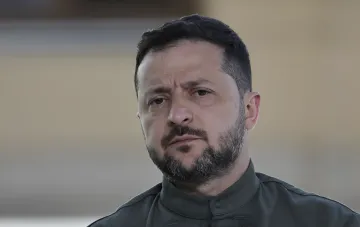
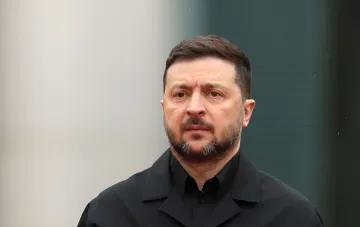
Against the backdrop of these statements, it should be noted that Ukrainian President Volodymyr Zelenskyy has repeatedly publicly proposed that Russia cease fire along the front line. In addition, in July the media reported that Ukraine and the United States were discussing a proposal for a so-called “air ceasefire” — a cessation of mutual strikes by missiles and drones; the Kremlin then stated that it was “premature” to comment on such publications. Also, last week it was reported that Kyiv had passed Moscow a proposal to cease attacks on civilian targets in the Black Sea, but no public response from Moscow to this initiative followed. Thus, behind the abstract term “exotic proposals” in Putin's statements, there appear to be quite specific initiatives on a local ceasefire and the protection of civilian objects.
Contradictory data
Here a notable discrepancy in presentation arises. From the Ukrainian side and from its partners, specific, substantive initiatives are mentioned: a ceasefire along the front line, an “air ceasefire,” and a halt to strikes on civilian targets in the Black Sea. At the same time, in the interview with Zarubin, these initiatives are characterized as “exotic” and “unacceptable,” while their content is not disclosed. That is, one side names the proposals by name and substance, while the other does so in a generalized manner with an evaluative tag that does not allow verification of which exact points are being discussed. An additional inconsistency concerns the timing: the exact date of the interview with Zarubin is not unambiguously fixed in open retellings, and the RBC-Ukraine publication is dated August 21, 2026, which makes the statement current at this moment but does not allow it to be tied to a specific negotiating episode. Both versions — the substantive initiatives of Kyiv and the generalized assessment by Moscow — coexist in the information space without public reconciliation.
In the end, Putin's statement confirms that formally Moscow is not closing the door to dialogue, but it puts forward a condition under which the initial parameters of a settlement are determined by the current situation on the front line. For now, specific initiatives on a local ceasefire remain without a substantive response from the Kremlin, and their public assessment is reduced to the non-specific label of “exoticness.” The dynamics will depend on whether at least one of the parties can translate these “probing” signals into the format of verifiable agreements.