A widespread discussion has broken out on the social network Threads about which specific actions at the beginning of a romantic relationship most people perceive as a display of feelings, while for other partners they become a reason for caution. The discussion was initiated by a user under the handle _rrrmmm__, who invited subscribers to name one gesture that "most consider romantic, but in reality, it is a complete red flag." In a short time, the thread gathered dozens of responses where people shared personal experiences and explained why certain scenarios, familiar from movies, cause irritation or anxiety in real life.
Unannounced visits and boundary violations
Among the most frequent examples mentioned in the comments were situations where one partner shows up at the other's home without warning and writes, "Come outside, I've arrived." For part of the audience, this looks like persistent courtship, but many female participants in the discussion directly linked such a gesture to a disregard for privacy. A separate case was noted where a person independently finds a girl's address and comes to her uninvited. In both cases, according to commenters, the core problem is the lack of opportunity for the second person to agree or refuse.
Control disguised as care
A separate layer of the discussion is devoted to jealousy and control, which are often justified by "strong feelings." One user called it a red flag when a partner cross-examines someone while calling it guardianship. Another gave concrete examples: forbidding a woman to wear a short skirt "due to the risk of catching a cold" or demanding to report her whereabouts every ten minutes. "Control disguised as care, jealousy," one participant formulated her position. Equally resonant was the example when a person is sick and explicitly asks not to come, but the partner replies, "Don't make things up, I'm already on my way." In this story, according to commenters, what matters is not the intention, but the ignoring of a clearly voiced desire.
Huge bouquets, giant toys, and public proposals
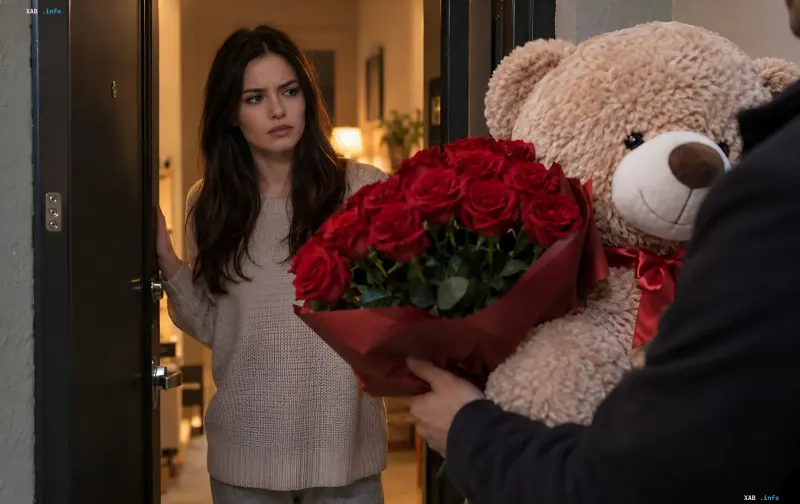
Not everyone appreciates overly demonstrative displays of feelings either. Commenters mentioned huge bouquets of dozens of roses, expensive gifts, and giant soft toys—gestures that are associated with romance in mass culture but cause discomfort rather than admiration for some people. One user briefly noted that such surprises do not thrill her. Another called broad gestures at the very beginning of an acquaintance a "red flag," as well as a marriage proposal after just a week or a month of dating. Public proposals also drew separate criticism: for some, it is a beautiful story, but for others, it is excessive pressure when an important decision is expected to be made in front of spectators.
Inequality, lack of consent, and the "conqueror scenario"
Another topic raised in the thread is the lack of equality in relationships. One user is annoyed by the situation when a man does not allow her to pay for herself, arguing with the phrase "because I'm a man." Another called the statement "I've already thought of everything and planned it" a red flag, when a partner does not ask the second person's opinion, but presents them with a fait accompli. Comments also mentioned a scenario in which a man acts as a "conqueror" and a woman as "prey," as well as couples who after many years of relationships still cannot move in together, and situations where one partner behaves like a child while the other is forced to constantly play the adult role.
What all the listed examples have in common
Despite the variety of specific situations, a common thread runs through the discussion: most of the "red flags" named by users boil down to one thing—the lack of consent and the right to choose. A surprise that leaves no room to refuse, care that turns into control, and a gesture that ignores a clearly voiced request are perceived not as love, but as a violation of personal boundaries. The discussion on Threads thus became not just a list of awkward scenarios, but a public conversation about the fact that in healthy relationships, romance is only possible when it aligns with the desires of both participants.