
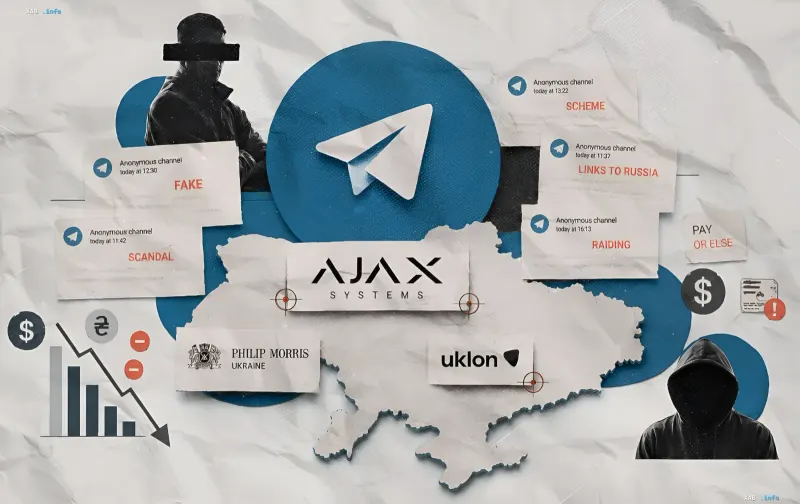
Ukrainian business, amid the war, remains one of the key elements of the state's economic resilience. However, according to an RBK-Ukraine investigation, a full-fledged "market" for the distribution of commissioned discrediting content targeting major companies has emerged in the Ukrainian segment of Telegram. Through anonymous channels and manipulative websites, Philip Morris, Meest China, Uklon and other structures have previously been targeted. In recent months, a similar campaign has continued against Ajax Systems and its founder, Oleksandr Konotopskyi. The combined audience of the 14 largest Telegram channels that regularly and systematically publish commissioned materials approaches 12 million readers.
The Mechanics of a Coordinated Campaign
According to observations by media market researchers, the mechanics of the attacks look similar in most cases. First, an initial publication appears — often on an obscure resource or in a small Telegram channel. After that, dozens of other channels pick it up almost simultaneously, repeating the same theses, and then individual formulations begin to be cited by websites or even major media outlets. Media expert Oksana Moroz notes that Telegram has become the main environment for launching such campaigns: "You only need to check a key phrase through search or a monitoring system — and you will see that the messages appeared almost synchronously. This is one of the clearest markers of a coordinated campaign." According to her, just a few years ago such campaigns often began on dubious websites before moving to social networks. Today, in most cases, Telegram itself becomes the primary platform, after which the information spreads through other resources.
Philip Morris, Uklon, Meest China: Who Is in the Crosshairs
Philip Morris Ukraine said it has repeatedly faced waves of discrediting campaigns. In 2024, according to the company, more than 200 negative publications were recorded in 66 Telegram channels with a combined audience of about six million users, and the scale of the campaign was estimated at over 100,000 dollars. PMU links such attacks to its consistent stance in the fight against the illegal tobacco market. In March 2024, Uklon CEO Serhiy Hryshkov publicly accused a notoriously scandalous Telegram channel of a "disinformation attack" that, in his words, escalated into "genuine digital terrorism." Hryshkov reported more than 300 negative publications over two months and claimed that the company was offered the chance to stop the campaign for 200,000 dollars. After that, Uklon turned to law enforcement agencies. A similar scenario was also described by Meest China co-owner Vyacheslav Lysenko: in 2024, a number of channels spread information about his alleged involvement in organizing an underground casino uncovered by the BEB. The businessman himself was not a subject of the criminal case and filed lawsuits in court to protect his honor, dignity and business reputation. In April 2025, a wave of publications affected the "Tekstil-Kontakt" group of companies. According to RBK-Ukraine, Ajax Systems employees also received offers from "intermediaries" to settle the matter for a financial reward.
"Digital Terrorism": A Threat to the Investment Image
In some of the cases that business has publicly disclosed, the information pressure was accompanied by demands to stop the campaign in exchange for a reward. This is why some business representatives call such practices "digital terrorism" or reputational extortion. Philip Morris Communications Head in Ukraine, Viktoriia Ilinska, notes: "In fact, the mechanics of most information attacks is very similar to the work of propaganda. It uses manipulative or knowingly false information, which primarily appeals to emotions." Coordinated information attacks on companies undermine not only the reputation of specific structures, but also trust in business as a whole, as well as the country's investment image in a situation where economic resilience is a matter of national security.
Contradictory Data
It is important to note that most of the quantitative indicators cited in the investigation — the number of publications, the size of audiences, the estimated cost of campaigns — are based on the statements of the companies themselves and expert assessments, rather than on an independent audit. Thus, the estimate of the campaign against Philip Morris of "more than 100,000 dollars" and the offer to Uklon of "for 200,000 dollars" are quoted from company representatives. RBK-Ukraine does not have independent confirmation of the exact amount of financial demands in each case. Moreover, the exact attribution of channels and their connection to specific clients has not been disclosed in the public domain: this concerns monitoring data and business statements, rather than court verdicts or investigation results. This means that the actual scale of the "market" may either match or differ from the figures cited.