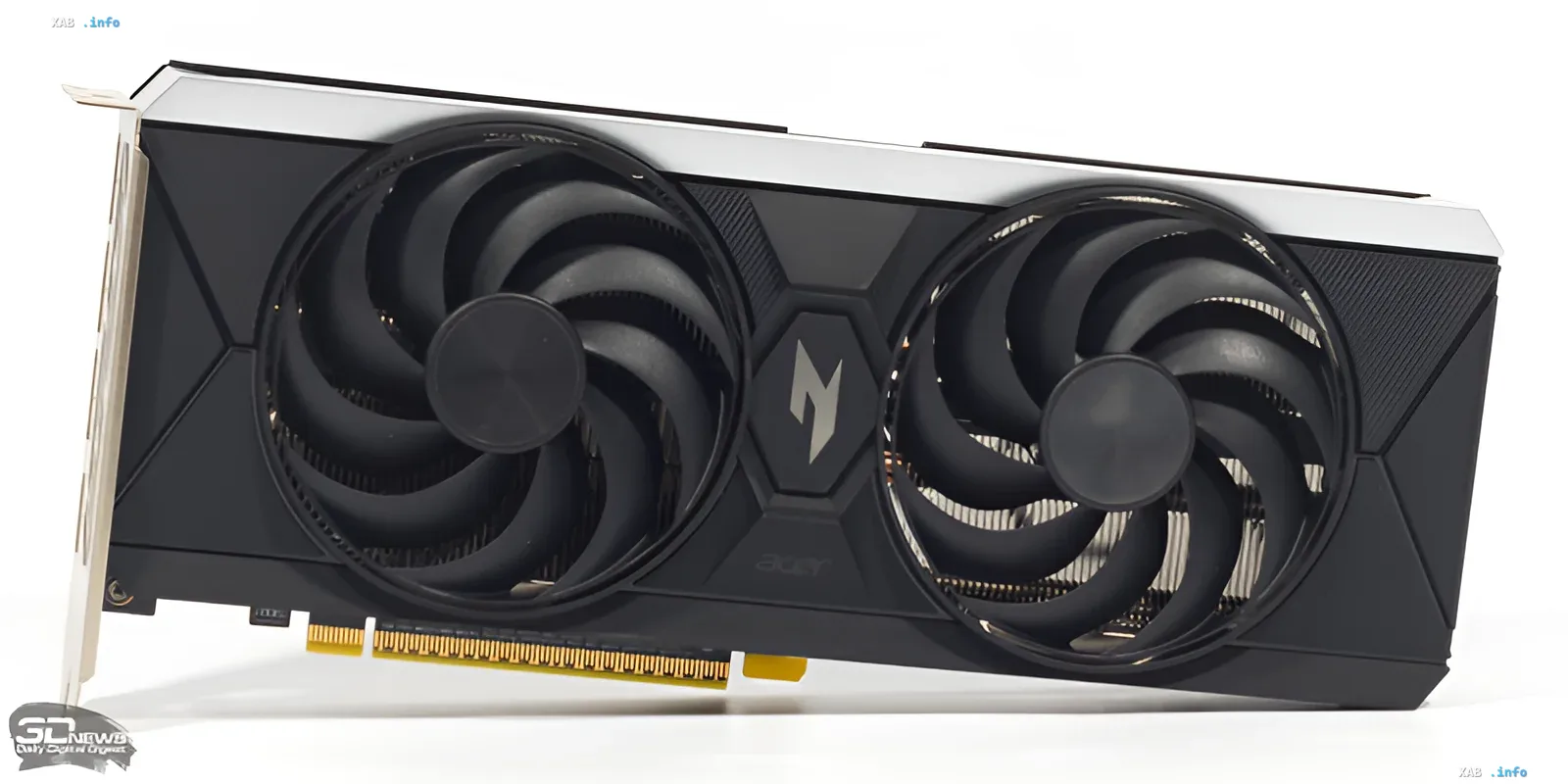
The second-oldest member of the Intel Arc family initially made a poor impression due to its inflated cost and remained in the shadow of the flagship model — the Arc B580, which offered a significantly better performance-to-price ratio. However, over time, the Arc B570 found itself in a more advantageous position, partly due to the high cost of assembling complete gaming PCs. Regardless, it is the cheapest accelerator of the current generation, and today we will examine one of the most affordable modifications of the Arc B570 — traditionally under the Acer Nitro brand.
Factory Overclock and Pricing Policy
The "OC" letters in the graphics card name indicate a factory overclock of the GPU: the target gaming clock speed was increased from the reference 2.5 GHz to 2.69 GHz. However, Acer does not specify the increase in power headroom, which is of paramount importance for Intel graphics cards.
The minimum price of the Acer Nitro Intel Arc B570 OC during the preparation of this article was 22,999 RUB, making the Acer product one of the most affordable variants of the Arc B570 in the Russian retail market. The direct competitors of the Intel Arc B570 are the GeForce RTX 5050 and Radeon RX 7600. Both accelerators cost more — 27,999 and 24,999 RUB, respectively — although they carry only 8 GB of VRAM compared to the 10 GB of the Intel Arc B570. Another point in favor of the Acer Nitro Intel Arc B570 OC is that the senior model in Intel's lineup — the Arc B580 — is currently at least 3,500 RUB more expensive, which is a significant amount in this price category.
Design and Cooling System
Due to moderate power consumption — 150 W — many variants of the Intel Arc B570 are satisfied with compact cooling systems. However, the Acer Nitro does not belong to this category, allowing us to expect low noise levels and component temperatures. The total length of the graphics card is 280 mm, and the thickness is within two expansion slots. The device has no LED backlighting.
The back of the PCB is covered by a metal backplate with holes for air passage. The cooling system is served by two fans with an impeller diameter of 89 mm. The radiator, in turn, represents a typical construction of two fin blocks threaded onto four heat pipes with a diameter of 6 mm. A copper heat spreader is attached to the GPU die, while separate aluminum plates soldered to the radiator fins are attached to the video memory chips and VRM components.
There are no thermal pads between the PCB and the backplate, so it does not participate in cooling the PCB. The accelerator receives additional power through an 8-pin connector of the old standard and does not have a backup BIOS chip with alternative settings.
Technical Details and Testing Methodology
The power system here is arranged in the same way as in the Intel Arc B570 samples we have encountered before. The GPU VRM operates on five power stages of Alpha & Omega AOZ5517QI with a nominal current of 60 A, controlled by the AOZ71137QI PWM controller. The power supply for the video memory chips is two-phase, based on 30-amp AOZ5507QI assemblies from the same manufacturer.
The Samsung GDDR6 chips with the marking K4ZAF325BC-SC20 are designed for a data transfer rate of 20 Gbps; however, the Arc B570, like the Arc B580, uses only 19 Gbps.
In most games, the average and minimum (we indicate the 1st percentile of the distribution) frame rates are derived from the array of individual frame rendering times or the instantaneous framerate obtained using the built-in benchmark. Exceptions are games without a built-in benchmark and most tests using frame generation: in these cases, we use the OCAT program to capture frame intervals.
Graphics card power is registered separately from the CPU and other PC components using the NVIDIA PCAT device. For stress tests, the game Cyberpunk 2077 is used with maximum graphics quality settings and ray tracing enabled or disabled at the maximum screen resolution (up to 3840 × 2160 depending on the amount of video memory). All parameter measurements are performed after the graphics card has warmed up, when temperature and clock speeds stabilize.
Important Nuances for Users
Regardless of how the Acer accelerator tests conclude compared to the "red" and "green" rivals, we remind you again that the performance of Intel discrete graphics largely depends on the Resizable BAR function. This feature must be taken into account when upgrading the GPU in legacy systems, where the Intel Arc B570 could provide not only additional performance but also a hardware codec supporting modern video formats.