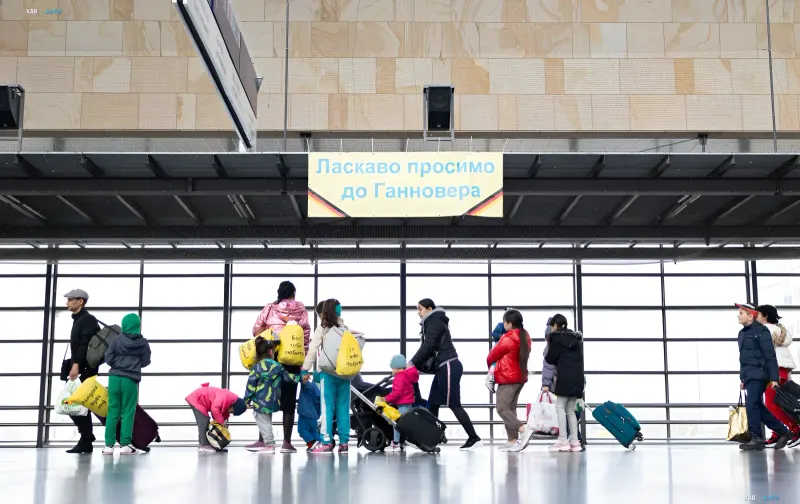
According to the latest Eurostat data published in August 2026, the number of Ukrainians under temporary protection in the European Union continues to show positive dynamics. In June of this year, the total number of refugees from Ukraine increased in 24 out of 27 EU member states. This trend indicates that, despite the years of war that have passed, migration flows have not only not dried up but have intensified in some cases, requiring partner countries to revise their integration and support strategies.
Germany, Poland, and Czechia: Main Centers of Accommodation
Germany holds absolute leadership in the number of Ukrainians accepted. As of the end of June, more than 1.28 million people were registered in the country, accounting for almost a third (29.2%) of the total number of Ukrainians under temporary protection in the entire European Union. Poland takes second place with a figure of 961 thousand people (21.8%), followed by Czechia, where about 390 thousand Ukrainians live (8.9%). These three states remain the main destinations for those seeking asylum or employment opportunities outside Ukraine.
Growth Dynamics and Statistical Anomalies
An analysis of monthly changes reveals an interesting picture of flow distribution. The most significant growth in absolute numbers was recorded in Italy (+4,115 people, an increase of 8.8%), followed by Czechia (+3,835 people) and Germany (+2,960 people). However, against the backdrop of general growth, three countries stand out where an opposite trend is observed. In Poland, the number of people under temporary protection decreased by 6,335 (-0.7%), while slight decreases were recorded in Belgium and Ireland. Experts link this to the fact that Poland, being a transit corridor, is gradually ceasing to be the final destination for many Ukrainians who continue their journey to Western European countries.
Demographic Portrait and Population Density
Statistics also reveal the structure of the refugee flow. Ukrainians make up the overwhelming majority (more than 98.5%) of all persons granted temporary protection status in the EU. In this group, adult women predominate (43.4%), followed by adult men (27%) and minors (29.6%). When calculating the relative burden on the population, Czechia (35.8 people per thousand residents), Slovakia (27.2), and Cyprus (26.8) differ by the highest density of Ukrainians. For comparison, the average figure for the EU is 9.8 people per thousand population.
Return Infrastructure: The "Home" Platform
An important aspect of the current situation is not only outflow but also return. For Ukrainians planning repatriation, a special digital platform called "Home" (Domoy) is functioning. It aims to simplify the return process by offering step-by-step instructions on finding housing, employment, and organizing education for children. This indicates that the migration policy of the EU and Ukraine is beginning to balance between supporting refugees and stimulating the return of citizens to their homeland.