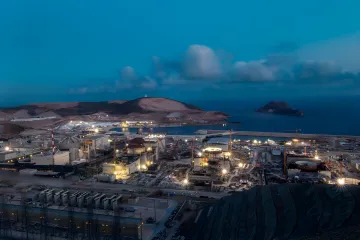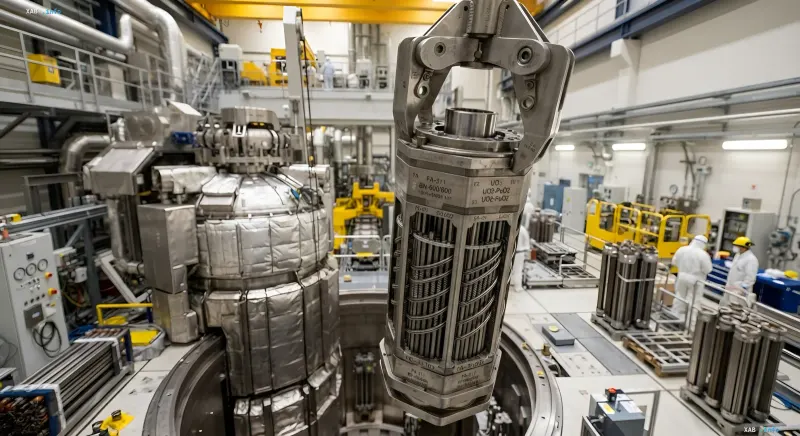
The state corporation Rosatom has announced the completion of equipment setup for the Pilot-Demonstration Center (PDC) in Zheleznogorsk, Krasnoyarsk Krai. According to company representatives, the complex is ready to begin pilot industrial processing of spent nuclear fuel (SNF), which is scheduled for launch in the near future. The facility's readiness was revealed following a visit by a delegation that included members of the State Duma, scientists from the Russian Academy of Sciences, and representatives of the FMBA and environmental organizations. The public demonstration of the ready-to-operate complex signaled that a key element of the new nuclear material management system has entered its final preparatory stage.
Facility Readiness and Public Demonstration
Completing the equipment setup is not merely a formality but a technological milestone: it means the PDC equipment is operational and has been verified under conditions close to full-scale production. Inviting such a broad range of participants—from legislators and academic scientists to healthcare and environmental advocates—indicates that the processing startup is viewed as a high-priority social and environmental project requiring societal transparency. It is at this stage, according to the corporation, that public trust for future industrial operation is built.
Closed Nuclear Fuel Cycle
The PDC is intended to be a part of the closed nuclear fuel cycle system. Its task is to extract valuable materials from spent fuel and return them to the production of new fuel for 4th-generation reactors. Thus, material that was historically treated as waste is converted into feedstock for the next generation of reactors. According to Rosatom’s plan, processed fuel will be used in fast neutron reactors, and recovered plutonium can be returned to the fuel cycle as MOX fuel. This transforms processing from a disposal stage into a resource regeneration process.
Underground Research Laboratory
Parallel to the processing startup, an underground research laboratory is being built in the vicinity of Zheleznogorsk, with an expected launch in 2031. Its purpose is to study options for the safe isolation of radioactive waste that cannot be reused. Thus, the closed cycle is supplemented by a research circuit: whatever remains after the extraction of valuable components will be studied for long-term safe storage. The combination of processing and an underground laboratory forms a full-circle nuclear material management system—from resource extraction to the isolation of residual waste.
Reduction of High-Level Waste by 2050
Rosatom expects that the development of processing technologies will significantly reduce the amount of high-level waste. According to Andrei Nikipelov, Deputy Director General of the corporation, if the current pace of building the necessary infrastructure is maintained, the generation of such waste from nuclear power plants could decrease by 100 times by 2050. This forecast directly links the scale of processing infrastructure to the environmental impact: the more fuel that is returned to the cycle, the less high-level waste will need to be isolated for the long term.
4th Generation Reactors: From Beloyarsk to “Proryv”
Processing in Zheleznogorsk is part of a broader program to develop 4th-generation nuclear energy. Pre-project work for the construction of a power unit with a BN-1200M reactor has begun at the Beloyarsk NPP. In the Tomsk region, as part of the “Proryv” (Breakthrough) project, a complex with a BREST-OD-300 reactor and an on-site closed nuclear fuel cycle is being built. According to Rosatom, this is the world's first project of its kind that integrates a reactor unit and fuel processing at a single site. The combination of these facilities—the PDC in Zheleznogorsk, the Beloyarsk NPP, and “Proryv”—forms the technological basis for the next-generation closed nuclear fuel cycle system.