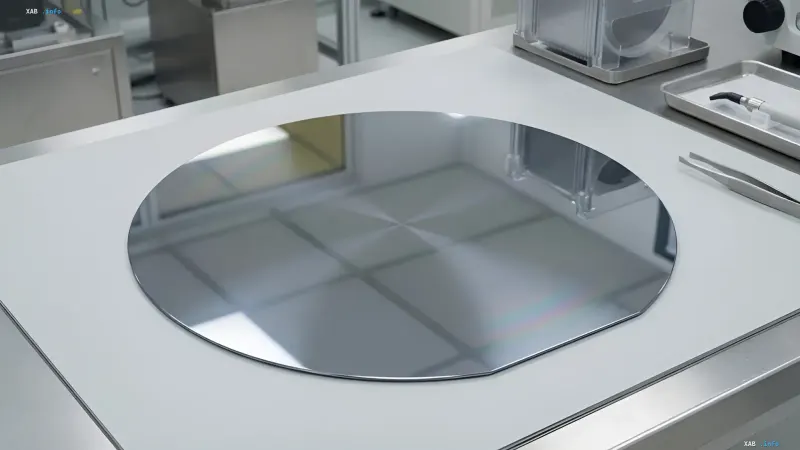
The Scientific Research Institute of Instruments (NIIP), part of Rosatom's structure, has filed a lawsuit in the Moscow Arbitration Court demanding to declare invalid the decision of the Ministry of Industry and Trade to unilaterally terminate a state contract worth 400 million rubles. The contract, concluded in late 2024, envisaged the implementation of the Vector-150 project—the creation of a domestic production technology for polished wafers of neutron-transmutation-doped monocrystalline silicon with a diameter of 150 mm. The court accepted the lawsuit for proceedings on November 2, 2026, with the first hearing scheduled for December 17, 2026.
Vector-150 Project: Goal and Deadlines
According to the terms of the state contract, NIIP was to develop a technology for growing special-purpose silicon ingots and prepare the production of polished wafers. The overall project implementation period is until the end of 2026. The first stage of work, which included the development of basic technological solutions, manufacturing of tooling, preparation of design and technological documentation, patent research, and creation of measurement methods, was due by May 15, 2026. According to the Ministry of Industry and Trade, failure to fulfill obligations regarding this stage became the basis for refusing further performance of the contract.
Ministry's Position: Fine and Termination
Citing the disruption of deadlines for the first stage, the Ministry of Industry and Trade imposed a fine of 1.5 million rubles on NIIP and decided to unilaterally terminate the contract. According to case materials, the ministry believes that the institute failed to fulfill its obligations within the established timeframe, giving the customer the right to terminate the agreement. The decision to terminate was made before October 18, 2026—the very date by which, according to NIIP, the institute was ready to submit the report for the first stage.
NIIP's Defense: Delays Caused by Late Customer Approvals
The institute insists that work on the project did not stop for a single day, and delays were caused, among other things, by untimely approvals from the Ministry of Industry and Trade. NIIP provides specific examples: a request for the purchase of polycrystalline silicon sent on April 25, 2025, received a response only on July 14 of the same year; the approval for purchasing a particle analyzer took about a month; equipment requested on October 31, 2025, was approved only on April 27, 2026. In addition, according to the institute, a request sent in February 2026 to postpone the deadline for the first stage went unanswered. By October 2026, NIIP states, the main technological solutions had been developed, tooling manufactured, draft design and technological documentation prepared, patent research conducted, measurement and preliminary testing methods created, and production preparation underway.
Strategic Importance for Power Electronics
The Vector-150 project is of fundamental importance for Russian power electronics. Neutron-transmutation-doped monocrystalline silicon with a diameter of 150 mm is used in the production of high-power thyristors and IGBT transistors—components in demand in electric transport, charging infrastructure, and energy. The contract's technical specifications explicitly stated that no similar production exists in Russia, and purchasing the corresponding material abroad is difficult due to its strategic purpose. Thus, Vector-150 involves establishing the technology for growing such silicon ingots in the country for the first time.
Litigation: What's Next
The Moscow Arbitration Court accepted NIIP's lawsuit on November 2, 2026. The first hearing in the case is scheduled for December 17, 2026. The plaintiff must prove that the Ministry of Industry and Trade's decision to terminate the contract and impose a fine is invalid, while the defendant must confirm the legality of the unilateral termination of the agreement. The outcome of the process could determine not only the fate of the 400-million-ruble contract but also the further implementation of Russia's only project to create production of strategic silicon raw materials for power electronics.