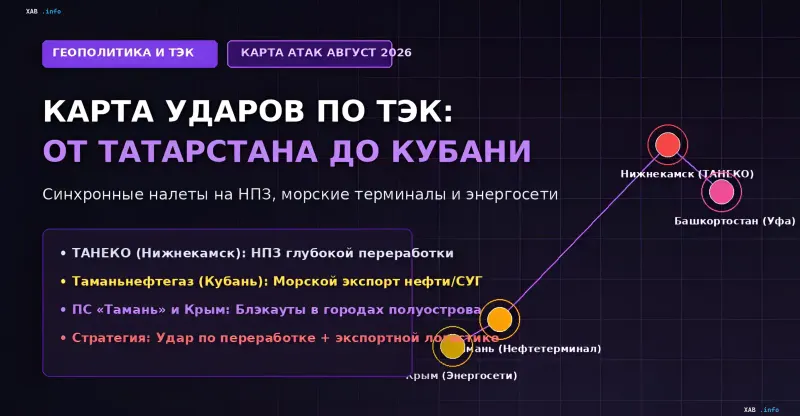
August 2026 is characterized by a shift from sporadic raids to coordinated combined strikes against Russian oil refining, export terminals, and power distribution networks. The operation on the night of August 20 demonstrated synchronicity across three geographical directions — the Volga region, the Kuban, and Crimea — a fact corroborated by both official reports and data from independent industry publications. For macroeconomic analysis, the key factor is not the fact of the incidents themselves, but their structural impact on the domestic fuel balance and export revenue.
Oil Refining and Domestic Fuel Balance
In Tatarstan (Nizhnekamsk), damage was recorded at the TANEKO oil refinery (PJSC Tatneft): fires broke out in the area of technological units, triggering the automatic fire suppression system. According to the General Staff of the Defense Forces, a fire arose on the territory of the plant, which is confirmed by reports from Ukrainian news agencies. This is not the first strike on the facility: as early as August 10, 2026, according to industry sources, drones struck the plant's distillation columns. The repeated damage to a major refining hub deep within the country is aimed at creating a shortage of refined products in the domestic market and exerting pressure on SPIMEX market quotes.
Export Logistics and Black Sea Terminals
The second direction of the strike on August 20 was the Tamanneftegaz marine transshipment complex in the port of Tamani (Volna settlement, Krasnodar Krai). This is the largest private terminal on the Black Sea, handling the transshipment of crude oil, fuel oil, diesel fuel, and liquefied hydrocarbon gases. The operational headquarters of the Krasnodar Krai confirmed a fire at the industrial facility and damage to pipeline and loading infrastructure. Similar incidents were recorded on August 12 in Novorossiysk and Tamani, where, according to industry publications, loading gantries were damaged. Regular raids on Black Sea ports (Tamani, Novorossiysk, Tuapse) hinder tanker loading and increase freight rates and insurance costs for foreign shipowners.
Crimea Energy System and Cascading Blackouts
The third direction is energy infrastructure: the 'Tamani' substation (Krasnodar Krai) and the 'Malorechenskaya' substation (Alushta district) were struck. Against this backdrop, local blackouts and emergency power outages were recorded in Sevastopol, Simferopol, Kerch, Yevpatoria, and Feodosia. The cascading nature of the outages points to the vulnerability of the peninsula's distribution networks, where power supply critically depends on a limited number of substations and submarine/land lines connecting to the mainland.
Doctrinal Shift: From Refineries to Export Infrastructure
If the focus of attacks in the spring of 2026 was primarily on refineries within a radius of 500–800 km from the border, August shows a clear dual strategy. The first direction is a strike on the domestic balance: disabling powerful refineries deep within the country to create a shortage in the domestic market. The second is a strike on export revenue: regular raids on Black Sea ports, hindering tanker loading. This combination simultaneously hits the consumer market and foreign currency revenue, increasing pressure on budget revenues from the oil and gas sector.
Macroeconomic and Legal Consequences
The long-term consequences are systemic. Damage to refining capacity reduces the supply of gasoline and diesel, which, with limited reserves, can lead to regional shortages and administrative price regulation. Damage to export terminals increases logistics costs and redistributes flows to alternative ports, increasing delivery time and cost. Legally and environmentally, the incidents raise questions of liability for hydrocarbon spills: the precedent of the environmental catastrophe in Tuapse (May 2026), pointed out by human rights activists and ecologists, demonstrates that the consequences of strikes on port infrastructure go far beyond direct material losses and include long-term obligations for cleanup and compensation.
Contradictory Data
There is a discrepancy in the assessment of the scale of consequences between various sources. Operational headquarters and Russian official channels typically record 'fires' and 'infrastructure damage,' emphasizing the local and controlled nature of the incidents. At the same time, the Ukrainian General Staff and a number of independent analytical publications characterize the August 20 strikes as paralyzing logistics and exports in the affected directions, i.e., taking facilities out of commission for an indefinite period. Formulations regarding Crimea also differ: some sources speak of 'local blackouts,' others of widespread emergency outages in several cities simultaneously. The degree of actual downtime of 'TANEKO' and 'Tamanneftegaz,' as well as recovery timelines, at the time of the review preparation, are not confirmed by independent audit and require additional verification.