The monthly report of the Organization of the Petroleum Exporting Countries (OPEC), published in September 2026, recorded a significant decline in Russia's crude oil production. According to the organization, citing secondary sources, Russia's oil output in August 2026 stood at 8.718 million barrels per day. This is 160,000 barrels less than the revised average for July and represents the largest monthly decline since December of the previous year, when, according to OPEC data, production began a sustained downward trend. It is separately noted that the August volume was 1.17 million barrels per day below the level Russia had committed to under the agreement with its OPEC+ alliance partners.
Scale of the decline and its place in the trend
A reduction of 160,000 barrels per day may seem modest against the backdrop of global production volumes, but in the context of Russia's oil industry it is the sharpest monthly drop in nearly nine months. As RBC-Ukraine emphasizes, citing the OPEC report, the downward trend began as early as December 2025 and has been sustained ever since. The gap of 1.17 million barrels per day between actual production and the quota agreed under OPEC+ indicates that Russia is not merely failing to meet its obligations, but is doing so with the largest deviation for the current phase of the alliance.
Ukrainian strikes as the key factor
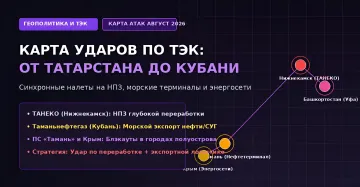
According to Bloomberg, the decline in production is occurring against a backdrop of systematic intensification of Ukrainian strikes on Russia's oil refining infrastructure and crude export facilities. In August 2026, according to the same sources, Ukrainian forces attacked oil refineries on Russian territory at least 22 times. The damage led to a forced reduction in oil processing at several plants. At the same time, strikes on port and transport infrastructure prevented Russia's largest oil companies from redirecting surplus crude to export. In particular, in August, vessels and facilities in Russia's southern ports were attacked, including Novorossiysk — one of the key centers for exporting Russian oil via the Black Sea.
Impact on the domestic fuel market and exports
Problems in the fuel sector have already been reflected in the domestic market and export policy. The Russian government extended the ban on most diesel fuel exports until the end of September 2026. In several Russian regions, restrictions on gasoline sales have been reintroduced — rationing, previously considered a temporary measure, has become the norm. Russian authorities, according to available data, are already revising their annual oil production forecast downward, linking this to the decline in crude processing volumes. Russian Deputy Prime Minister Alexander Novak, in public statements, characterizes the current drop as "temporary," claiming that after the refineries are restored and the situation stabilizes, production volumes will rise again.
Contradictory data
When comparing data from various sources, discrepancies emerge in assessing the production dynamics across the entire OPEC+ alliance. According to the report cited by 1prime.ru, OPEC+ oil production, including the UAE, rose by 0.3 million barrels per day in August 2026. At the same time, TASS, citing the same September OPEC report, reports that OPEC+ countries increased production by almost 630,000 barrels per day. The nearly twofold difference may be explained by different calculation methodologies (inclusion or exclusion of certain countries, revision of baseline figures), but in public materials both figures are given without a detailed explanation of the discrepancies. As for Russia, its decline of 160,000 barrels per day against the overall OPEC+ growth means that the other alliance members more than compensated for Russia's reduction, which further increases pressure on Moscow within OPEC+ internal consultations.
Outlook and assessment of the trend's sustainability
The combination of several factors — physical damage to refining capacity, export restrictions via the Black Sea, domestic fuel shortages, and the need to reallocate logistics — creates structural, not merely cyclical, pressure on Russian oil production. Deputy Prime Minister Novak's statement about the "temporary" nature of the drop is not supported in the OPEC report by any specific recovery timelines. On the contrary, the downward revision of the annual forecast indicates that Moscow is factoring in the continuation of negative dynamics at least until the end of 2026. The next monthly OPEC report, expected in October, will be a key indicator of whether the downward trend persists or a recovery begins after repair work at the damaged plants is completed.