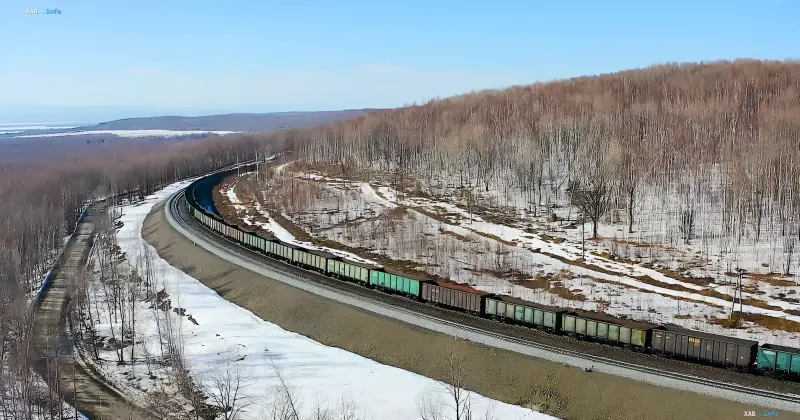
On November 4, at the Economic Forum of the UN Special Programme for the Economies of Central Asia (SPECA), Russia announced plans to significantly increase the carrying capacity of the Trans-Siberian and Baikal-Amur mainlines. According to Russian representative Kirill Logvinov, the capacity expansion aims to strengthen transport corridors connecting Eurasia and ensure sustainable cargo transit between key regions of the continent.
Target Capacity Indicators
According to Kirill Logvinov, the goal of the Trans-Siberian and Baikal-Amur railway development project is to increase their throughput capacity to 210 million tons by the end of 2030 and to 270 million tons by the end of 2032. Thus, the stated targets involve a phased capacity buildup over several years, which will increase the volume of freight transported in the eastern direction.
Strategic Importance of International Corridors
Emphasizing the priority of developing international transport corridors for Russia, Kirill Logvinov stated that transit routes through the Russian Federation provide short and uninterrupted connections between Central Asia, South Asia, Southeast Asia, the Persian Gulf countries, and Europe. It is this connectivity, he noted, that determines the significance of the mainlines for Eurasian logistics.
North-South Corridor and Alternative to the Suez Canal
The Russian Foreign Ministry representative also stated that tariff and technological conditions along the routes of the North-South International Transport Corridor are actively improving. The North-South International Transport Corridor is a multimodal route about 7,200 km long, including water, rail, and road routes for freight transportation between Russia, Iran, India, and the countries of the Caspian Sea and the Persian Gulf. Russia views this corridor as an alternative to the Suez Canal, with the main advantage being a reduction in cargo transit time.
International Cooperation and Infrastructure Initiatives
Kirill Logvinov added that Russia is actively cooperating with the UN Economic Commission for Europe and the UN Economic and Social Commission for Asia and the Pacific, promoting initiatives to connect Eurasian routes, simplify cross-border procedures, and develop a network of dry ports. Earlier, the draft action program of the United Russia party also provided for supporting the development of international transport corridors passing through Siberia and the Far East, with an emphasis on modernizing cross-border port and warehouse infrastructure.