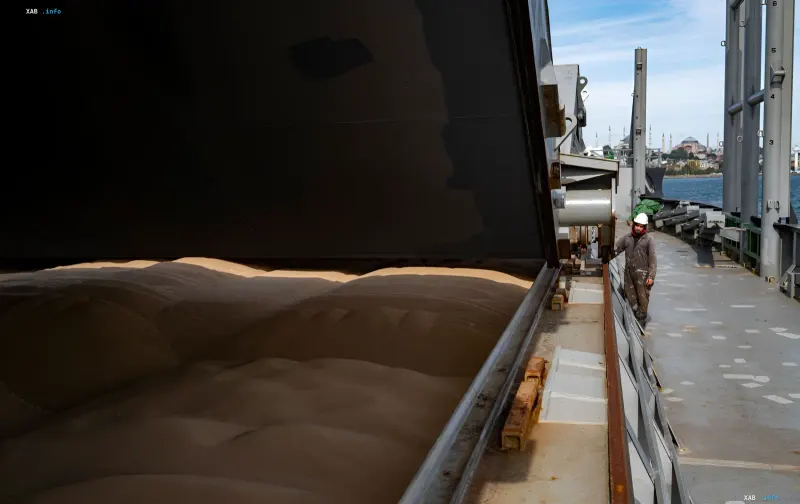
Russia's grain industry is facing a systemic logistical crisis that, according to the press service of the Russian Foreign Intelligence Service (SVR), is causing the domestic agro-product market to collapse. Between 1 and 20 August 2026, grain export volumes fell 2.5-fold — to 1.4 million tonnes — while wheat shipments dropped 2.6-fold. Forecasts suggest that in September wheat exports could fall by a further 52.1–62.5%, to 1.8–2.3 million tonnes, which would be the lowest figure since 2010. Infographic: the photo shows a grain bulk carrier against the Istanbul skyline, illustrating the dependence of grain transit on Black Sea routes.
Export Collapse: Figures and Forecasts
The key cause of the crisis is the disruption of the logistics chain in the southern ports, through which, according to the SVR, up to 70% of Russia's grain exports passed. Alternative routes do not have sufficient throughput capacity to compensate for the loss of the Black Sea directions. The redirection of cargo to the Baltic Sea, confirmed by a number of international outlets, adds up to $30–50 per tonne to the cost, making exports less economically viable and accelerating the build-up of unsold stockpiles within the country.
Domestic Market Under Pressure: Prices Plummet
The oversupply of grain on the domestic market is already being reflected in prices. In a single week, the cost of wheat, barley, sunflower and soy in Russia fell by 3.3–8.5%, and over the year the decline exceeded 40%. The most affected by the crisis was one of the country's largest agro-holdings — "Rosagro" — whose net profit for the first half of 2026 crashed by 99%: from 4.8 billion rubles to 55.88 million rubles. These data, published in the SVR report, have not yet been confirmed by independent financial sources, although analysts have been noting a trend toward margin compression in the grain sector for several months.
State of Emergency in Rostov Region and the Kremlin's Response
Rostov Region, which accounts for nearly 10% of Russia's harvest, declared a state of emergency on 28 August 2026 due to the inability to export grain normally. In response, according to the SVR, the Kremlin is preparing a package of measures: state purchases, preferential loans, subsidies and loans secured by unsold harvest. The cancellation of the export duty and compensation for transport costs to alternative ports are also under consideration. However, the intelligence agency emphasises that these tools will not solve the structural problem: "Preferential loans will not create demand, subsidies will not increase port throughput, and cheap money will not replace broken logistics."
Baltic Dead End and the Threat of Further Restrictions
The attempt to redirect exports to the Baltic Sea, reported by Delfi and other outlets, runs into a new barrier: Latvia and Lithuania, according to Reuters and Deutsche Welle, are considering the possibility of fully closing their ports to Russian grain. If this decision is implemented, the alternative route, already burdened by higher logistical costs, will be at risk. Thus, Russia is facing a double squeeze: the Black Sea ports are not operating in their previous mode, while the Baltic ports may be closed by a political decision of the Baltic states.
Contradictory Data
On the one hand, the SVR report paints a picture of total logistical failure: exports have collapsed, stockpiles are growing, and state measures are unable to compensate for the loss of throughput capacity. On the other hand, data from Delfi and other sources confirm that the redirection of part of the cargo to the Baltic is already taking place — that is, this is not a complete paralysis but a sharp decline in efficiency. Moreover, the specific financial figures (the 99% collapse of "Rosagro" profits, exact export tonnages) are cited exclusively in SVR materials via RBC-Ukraine and have not been independently verified by any additional source. Finally, while the SVR focuses on "broken logistics" as the main factor, Baltic outlets emphasise the political component — a potential ban on transit that could turn a partial crisis into a full one.
Global Context: Wheat at a Three-Year High
The crisis in Russian grain exports does not exist in a vacuum. At the same time, Ukraine, whose exports are also suffering from shelling of ports in the Black Sea, is forced to take emergency measures to preserve logistical channels. Against the backdrop of uncertainty around both of the largest Black Sea exporters, the global price of wheat has reached a three-year high. This creates a paradoxical situation: the domestic markets of Russia and Ukraine are under pressure from an oversupply of unsold product, while global prices are rising due to a reduction in supply on external markets.