The Main Directorate of Intelligence of the Ministry of Defense of Ukraine, in a report cited by RBC-Ukraine, stated that Russia is systematically expanding its presence in Africa's energy sector and using it as a tool for geopolitical pressure and creating a circle of states dependent on Moscow. According to intelligence estimates, the Kremlin is primarily betting on nuclear energy while simultaneously entering other technological niches. As an illustration, the report cites an event at the Egypt Energy 2026 conference, where the Russian state corporation Rosatom signed an agreement with an Egyptian technology company on localizing the assembly of energy storage systems in Egypt.
Egypt as a Bridgehead and a Bet on Nuclear Energy
According to the HUR data, the Kremlin expects this cooperation to strengthen Russia's position on the Egyptian energy market, turn Egypt into a bridgehead for promoting Russian technologies across the entire continent, and create mechanisms to bypass Western sanctions. At the same venue, the parties discussed the further implementation of the El Dabaa NPP construction, the basic agreements for which, according to intelligence, were concluded back in 2015–2017. A separate priority project for Moscow in the region remains the promotion of the PEB-100 floating nuclear power unit with a capacity of 100 MW.
Mechanism of Long-Term Dependence
The HUR emphasizes that Russia's participation in creating nuclear infrastructure automatically implies the centralized maintenance of nuclear fuel exclusively on the territory of the Russian Federation. According to intelligence conclusions, this places African countries in critical long-term dependence on Moscow and gives the Kremlin direct leverage over their energy security and foreign policy. Thus, according to Kyiv's version, technological ties to Russian nuclear energy are turning into a political tool to keep the region's states within its sphere of influence.
Training Personnel for Russian Standards
Parallel to infrastructure projects, Russia is reportedly training personnel for its own standards: currently, about 400 students from more than 20 African countries are studying nuclear energy in Russian universities. Intelligence interprets this as part of a unified expansionist strategy aimed at securing long-term levers for Moscow in the region.
Beyond Energy: Recruitment and the Military-Industrial Complex
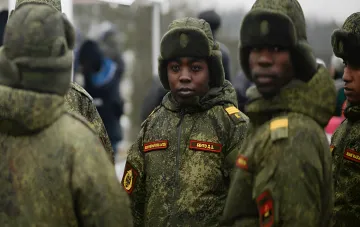
The report recalls that Moscow's interest in Africa is not limited to energy: the Kremlin, according to the authors, systematically uses the region's economic vulnerability for the needs of its own military-industrial complex and to replenish the army. In particular, citing an investigation by the Ukrainian Center for Security and Cooperation, it is indicated that Russia attracts women from Africa to produce Geran drones through an extensive transnational network that recruits female citizens of African countries to strike drone assembly plants in the Russian Federation under the guise of the Alabuga Start educational and labor program. In addition, according to available data, the Russian Federation is massively recruiting Africans for the war against Ukraine, relying on the poorest states – Burundi, Zimbabwe, Sierra Leone, and even Madagascar; Ukraine, as reported earlier, has identified more than 5,400 citizens of African countries whom Moscow, as it claims, lured into the ranks of the occupation army through deceit or promises of high earnings.
Intelligence Assessment: A Unified Retention Strategy
The HUR concludes that the combination of energy, personnel, and recruitment steps is part of a unified Russian expansionist strategy to keep African states within its sphere of influence. All listed statements and figures are provided with reference to the HUR of the Ministry of Defense and the specified investigation; independent cross-verification of individual assessments within the provided sources was not carried out.