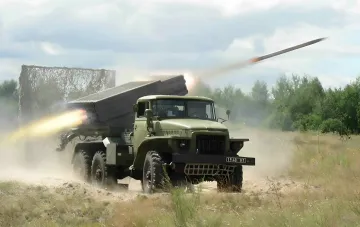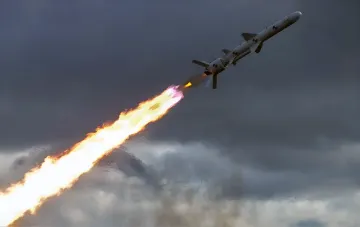
On Friday, August 28, the Russian Armed Forces launched a massive strike on Ukraine, employing S8000 'Banderol' ballistic missiles and nearly a hundred strike drones, the majority of which were jet-powered. This is reported by RBC-Ukraine, citing a statement from the Air Force of the Armed Forces of Ukraine. According to military data, over the course of the day — from 6:30 to 19:00 — the enemy attacked Ukraine with seven S8000 'Banderol' missiles and 96 strike UAVs, of which more than 70 were jet-powered drones. As the Air Force emphasized, the enemy directed the majority of the drones toward Kyiv.
Nature of the weapons used
The attack again featured S8000 missiles, which in open sources are called 'Banderol' and classified as ballistic systems. It is precisely the combination of ballistic missiles with a massive wave of jet-powered drones that makes such strikes particularly difficult for air defense systems: jet-powered UAVs fly faster and at greater altitude than ordinary 'Shaheds,' which reduces the time available for interception. As of 19:00, the Air Force noted that approximately 10 enemy jet-powered drones were still in Ukrainian airspace.
Air defense performance
Preliminary data indicates that Ukrainian air defense shot down or suppressed six 'Banderol' missiles and 73 strike drones over the course of the day. Thus, the overwhelming majority of the weapons employed were intercepted, although some targets likely reached their designated areas. Military officials stress that the final figures from the strike are being refined, as the assessment of air defense effectiveness is carried out as data comes in from impact sites and observation assets.
Kyiv under constant fire
The capital and its surroundings remain in the epicenter of the attacks: over the past two days, Russian occupiers have, according to available data, carried out 38 strikes on Kyiv and the Kyiv region. The day before, air raid alerts were sounded 13 times in the capital, and on August 28 — eight times already. Such a frequency of signals indicates that the city is effectively under continuous threat of air raids, and the civilian population is forced to take shelter in bomb shelters multiple times a day.
Strikes on civilian infrastructure
In addition to the air attack, Russia struck civilian infrastructure. In the Bilohorodka community, the occupiers attacked 'Nova Poshta' warehouse facilities: after the first hit, they struck the same location two more times while firefighting was still ongoing at the site. In addition, on the morning of August 28, Russian occupiers struck the 'Episenter' shopping center in Zaporizhzhia — as a result of the shelling, the building was damaged and one person was injured. These episodes demonstrate that it is not only military targets but also civilian facilities, including logistics and retail, that come under fire.