
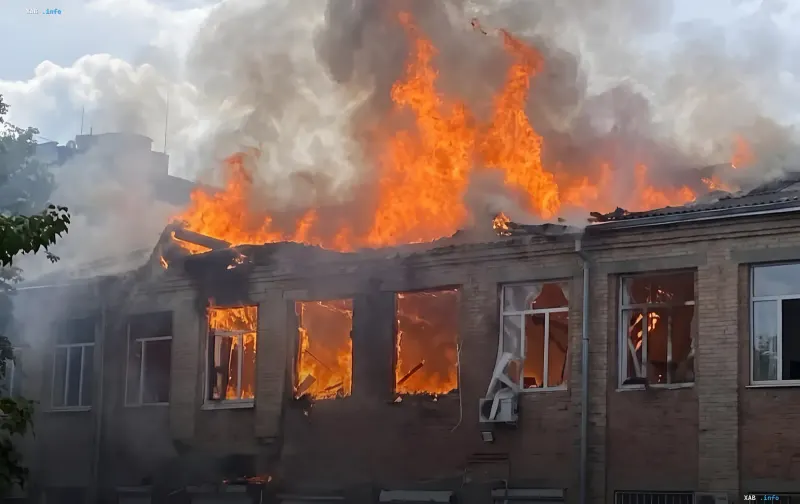
On Wednesday, September 2, 2026, Russian occupation forces struck the grounds of the National University of Food Technologies (NUFT) in Kyiv with an unmanned aerial vehicle. According to the university's press service and a statement by Minister of Education and Science Andriy Butenko, several university buildings were damaged as a result of the attack. Published footage shows tongues of flame shooting out of second-floor windows, while a thick column of black smoke rises above the roof. As of the time the official statements were published, no students or faculty members had been injured.
Timeline and details of the strike
The attack on the university took place during the day on September 2, as part of a broader wave of strikes on Kyiv. As Minister of Education and Science Andriy Butenko stated in his official statement, Russia struck NUFT during daylight hours. "University buildings have been damaged. There are no injuries among students or faculty," he emphasized. Butenko also thanked the university's leadership and staff, who, in his words, organized the educational process taking all security risks into account. According to Ukrainian media, around 160 students were in the university buildings at the time of the attack and were evacuated to shelters in accordance with civil defense protocols.
Condition of the buildings and first photos of the aftermath
NUFT's press service reported in its first statement of "significant damage to several buildings." Photographs published on social networks document extensive damage: fire engulfed the roof and upper floors of several buildings, windows were blown out, and structural fragments collapsed. The university's statement stressed that "a university is first and foremost its people, and as long as we stand together, it cannot be destroyed." Emergency services promptly began extinguishing the fire and assessing the extent of the material damage.
Context: what is known about NUFT
The National University of Food Technologies is one of the oldest and most influential universities in Ukraine, founded in 1919. Over the decades, the university has trained thousands of specialists in food industry, biotechnology, and agrochemistry, and its graduates hold leadership positions in the country's largest industry companies. The strike on an active educational institution, where hundreds of students and faculty members were present at the time of the attack, has caused particular concern in society and underscores Russia's systematic practice of targeting educational facilities.
Contradictory data
A discrepancy in the assessment of casualties has been recorded in the statements of two official sources. NUFT's press service, in its first message published immediately after the strike, stated: "The number of casualties is being clarified." Meanwhile, Minister of Education and Science Andriy Butenko in his statement already concluded: "There are no injuries among students or faculty." Thus, the university's initial uncertainty was resolved at the level of the relevant ministry. In addition, in the headlines of several publications (Ukrainews) the strike is described as having been carried out "during classes," while other sources (Ura-Inform) clarify that 160 students were in shelters at the time of the attack. Both formulations do not contradict each other: classes were in progress as usual, and upon the alarm being sounded, students were evacuated to protective structures.
Broader context: strikes on Kyiv on September 2
The attack on NUFT was part of a series of strikes on the capital recorded on September 2. In addition to the university, Russian drones struck a warehouse building in Kyiv. In the Holosiivskyi district, a fire broke out after an enemy strike, which was extinguished by rescue services. The overall picture of the attack indicates a multi-vector nature of the strikes, directed simultaneously at civilian infrastructure and educational facilities.