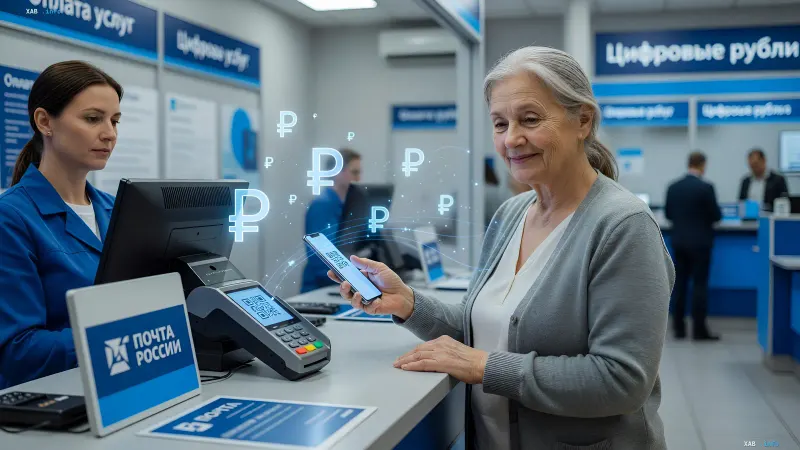
Russian Post has announced a full transition to accepting digital ruble payments in all its branches across the country. The new payment method was implemented by the subsidiary IT company PochtaTech in collaboration with VTB Bank on the Bank of Russia's technological platform. The postal operator's press service announced this on November 16, 2026. Now, any client visiting a Russian Post branch can pay for postal, banking, and other services by scanning a QR code via a banking app that supports digital currency operations.
Payment mechanics: from wallet to QR code
To use the digital ruble, a client must first open a digital wallet in the application of one of the participating banks. Payment at the post office then follows a standard scenario: the cashier generates a QR code on the terminal, the client scans it with their smartphone camera, confirms the transaction in the banking app, and the payment is completed. All transactions pass through the Bank of Russia’s unified platform, which eliminates direct interaction between commercial banks during settlement. For individuals, transfers and payments in digital rubles are commission-free, and funds can be transferred to other users by phone number regardless of their servicing bank.
Digital ruble: the third form of national currency
The digital ruble is the third form of Russian currency, alongside cash and non-cash money. The fundamental difference from funds in commercial bank accounts is that the digital ruble is a direct obligation of the Bank of Russia, rather than a specific credit institution. This means that even in the event of problems at the commercial bank where the wallet is opened, the funds in the digital wallet are protected as obligations of the central bank. This status makes the digital currency an attractive instrument for mass use in retail and government payments.
Implementation timeline: from pilot to nationwide launch
The integration of the digital ruble into Russian Post's IT infrastructure began in February 2026. PochtaTech and VTB adapted the company's existing payment services for digital currency: cash terminal modules were redesigned, interaction protocols with the Central Bank's platform were updated, and a series of stress tests were conducted. The first test transaction under real-world conditions was carried out in September 2026. Following the pilot period, the system was declared ready for scaling, and on November 16, 2026, Russian Post announced the launch of digital ruble acceptance in all branches across the country — from large city hubs to small rural offices.
Context: the post office as a channel for financial inclusion
The Russian Post network consists of over 40,000 branches and collection points, making it one of the most accessible channels for financial services in the country, especially in small towns and rural areas. Introducing the digital ruble into this network expands reach to the population that previously may not have had access to digital financial tools. Free transactions for individuals and the ability to pay via QR code without the need to open a traditional bank account simplify the first step into the digital economy. Experts note that scaling the digital ruble through Russian Post's infrastructure aligns with the Bank of Russia's strategic goals of ensuring equal access for citizens to all forms of national currency.
What this means for the customer
For the average Russian Post customer, the new payment method does not require additional devices or cards: a smartphone with a participating bank's app installed and an open digital wallet are sufficient. Paying by QR code takes only a few seconds and involves no commission. Customers can use digital rubles to pay for shipments, postage, bank transfers, and any other services provided at the branch. Thus, Russian Post is becoming one of the first mass retail channels where the digital ruble is available on par with cash and bank cards.