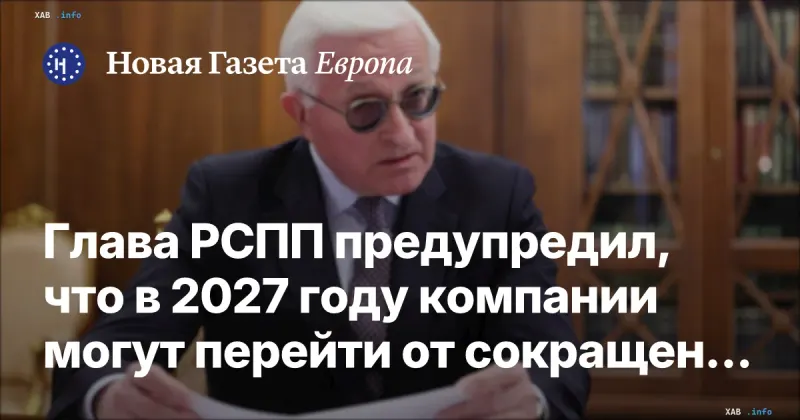
Russian enterprises that have been maintaining their headcount by shifting staff to a shortened work week may begin mass layoffs in 2027. This forecast was delivered on November 14, 2026, by Alexander Shokhin, President of the Russian Union of Industrialists and Entrepreneurs (RSPP). According to him, the economic rationale for holding onto excess staff has been largely exhausted against the backdrop of a lack of positive expectations regarding demand recovery.
Economic Reasons for Potential Staff Optimization
The main factor pushing employers to reconsider personnel policies is the combination of a high key interest rate, increased tax burdens, and a decline in budgetary stimulus. Alexander Shokhin emphasized that under conditions where forecasts for 2027 remain pessimistic, maintaining the current workforce size has become a social, rather than economic, endeavor for businesses. The absence of domestic and external demand, coupled with a lack of incentives for investment other than the restoration of damaged production facilities, is forcing company management to explore cost-cutting options.
Monetary Policy and GDP Forecasts
The head of the RSPP does not expect any easing of monetary policy from the Bank of Russia until at least February 2027. The expert points out that tight lending conditions, combined with fiscal changes, threaten economic growth. According to Shokhin's assessments, if the current trajectory continues, the country's economy risks facing near-zero growth or even a contraction next year, which contrasts with the Central Bank's baseline forecast of 1–2% GDP growth. The business representative suggested that the state consider tax deferrals for systemic enterprises to prevent a sharp spike in unemployment.
Labor Market and Social Sphere Context
The labor market, according to Rosstat, remains stable for now, with unemployment at 2.2% in September. However, experts point to worrying signals: in 2026, large-scale cuts in social spending were recorded, affecting medicine and education. Calculations show that since the beginning of the year, these sectors have been underfunded by at least 1.05 trillion rubles. Against this backdrop, the business sector's shift from a shortened work week to actual layoffs could pose a serious challenge to the socio-economic stability of regions.
Future Outlook
In the coming months, the key indicator of the economy's state will be the business reaction to budgetary parameters and the regulator's rhetoric. If Shokhin's predictions regarding investment stagnation and lack of demand prove accurate, the labor market may face a structural overhaul. The support measures proposed by the RSPP, including payment deferrals for major regional employers, could serve as a tool to mitigate crises, though their implementation will depend on the authorities' willingness to adjust fiscal policy ahead of the challenging 2027 economic cycle.