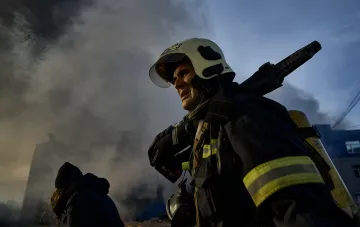
In two months of hostilities, Russia has destroyed nearly half of Ukraine's annual book production volume. According to publisher estimates, total losses amount to 15 million copies, and among the burned print runs are 9% of the new school textbooks. On the night of August 28, 2026, a fresh Russian strike hit a Nova Poshta distribution center in Svyatopetrivske, Kyiv Oblast, where book stocks belonging to at least three dozen Ukrainian publishers and book retail chains were concentrated. As a result of the strike, Vivat, "Nash Format," "Ranok," "A-ba-ba-ga-la-ma-ga," "Knyholav," "Laboratoriya," BookChef and other companies were affected. This is not an isolated incident: on August 1, a Russian strike on a "Ranok" publishing warehouse destroyed around 10 million books, including more than a million textbooks for grades 4 and 9, and on August 28 the publisher sustained damage again.
Scale of the losses: from 16.6 million hryvnias to a billion
Each affected publisher assesses the damage in its own way, but taken together the picture amounts to a systemic crisis for the industry. Yulia Orlova, CEO and co-founder of Vivat, reported that the company's direct losses from the strike on the warehouse in Svyatopetrivske amount to about 16.6 million hryvnias, however books belonging to other publishers and bookstores were also located at the same facility and suffered significant damage. The publisher is in negotiations with the management of the distribution center and Nova Poshta over compensation for part of the losses. Far larger figures are cited by the "Ranok" publishing corporation, which includes the imprints "Fabula," "Zhorg," "Redberry," VG Osnova, "Varvar-comix," "Korali" and "She odnu storinku." General Director Viktor Kruglov estimates the corporation's total losses at approximately 1 billion hryvnias. "To get back to our previous working volumes, it will take 3–5 years; most likely, not all titles will be reprinted. Because we will not reprint category C books in terms of turnover. But these could be critically important publications, such as popular science books on the exact sciences," Kruglov stated. The publisher's team has already agreed to cancel all bonuses and reduce salaries, and is in negotiations with banks over the first tranche of credit financing.
The market shrinks: print runs, staff and prices
The consequences of the strikes go far beyond the burned print runs. The destruction of warehouse infrastructure, the decline in the population's purchasing power and the loss of working capital are forcing publishers to rethink their entire business model. "Some people are leaving the country, some are visiting shopping centers less often, for many books are becoming less affordable — demand is shrinking. Publishers are cutting print runs, receiving less working capital, and therefore investing less in new projects. Vivat is also forced to reduce its staff. For me this is one of the most painful decisions I have had to make in the past 14 years," Orlova said. Industry experts expect that in the coming months retail book prices will inevitably rise: increased logistics costs, the rising cost of binding and paper, as well as the need to reprint lost runs will be factored into the final price. At the same time, publishers do not yet record a mass shift of readers to the digital format — at Vivat, e-books account for around 5% of the paper print run in sales.
Survival strategy: decentralization and abandoning export
One of the key decisions being discussed by publishers is the decentralization of fulfillment. Nova Poshta is already developing a corresponding system that allows large volumes of goods not to be concentrated in a single location. "But it is not enough simply to spread books across different warehouses. You need software, professional warehouse logistics and a system that will allow orders to be quickly assembled and shipped from different points," they note at Vivat. Orlova acknowledges that such an approach will increase the time and cost of logistics, however decentralizing warehouses is becoming one of the mechanisms for business survival in wartime conditions. Publishers do not plan to ship books abroad: Ukrainian book publishing enjoys a VAT tax benefit, whereas books imported from abroad are subject to taxation, which creates additional costs. Against the backdrop of September 1, publishers are also promoting support initiatives: the organization "Eksperyment" calls on readers to buy books and talk about them on social media, and Orlova herself suggests giving schoolchildren books rather than flowers, which will remain in school libraries.
Contradictory data
All the key figures cited in this material are self-reports by the affected publishers and have not undergone independent audit. The estimate of "nearly half of the annual volume" and the combined "15 million copies" are given by publishers as expert approximations based on internal warehouse data. At the same time, the specific figures for individual companies (10 million books at "Ranok," 16.6 million hryvnias at Vivat, 800,000 books at BookChef, 60,000 at Readeat and Book.ua) collectively fit within the overall range, but their exact verification is currently impossible. In addition, the discrepancy in scale between the "15 million" claim and the sum of individually confirmed losses (around 11–12 million) may be explained by the fact that some publishers have not yet finished their tally, as well as by the fact that some runs were partially rather than fully destroyed. Until the data from an independent expert assessment is available, all figures should be regarded as preliminary.
Ukrainian book publishing is perhaps experiencing its heaviest blow since independence. But, as the publishers themselves emphasize, the industry is not about to stop. "We'll still fight," Yulia Orlova concludes, and in these words is probably reflected the general mood of the industry: not simply to wait it out, but to restructure logistics, revise print-run policy and stay in the market, despite the fact that half of the annual production has already turned to ash.