
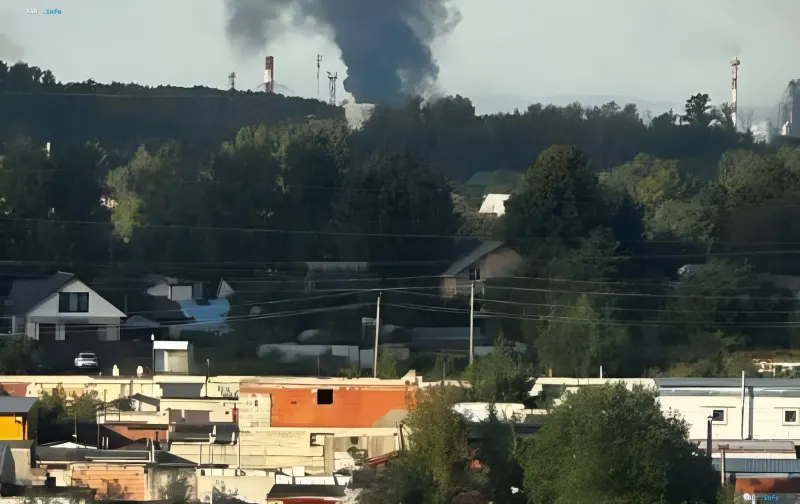
Ukrainian drones delivered precision strikes on the key primary oil processing units of the Ryazan Refinery — one of Russia's largest oil refineries. RBC-Ukraine reports this, citing data from the company FirePoint, which published footage of the attack and confirmed the type of equipment hit. According to FirePoint, FP-1 drones struck the rectification columns of the ELOU-AVT-6 unit — the refinery's largest primary processing complex with a capacity of 8.5 million tonnes per year — as well as equipment of the AVT-3 unit with a capacity of 3.1 million tonnes per year.
Confirmed hits on key units
Rectification columns are the central equipment of any primary processing unit: it is in them that crude oil is separated into fractions. Hits on them typically mean prolonged downtime and costly repairs, rather than a local incident. FirePoint notes that both complexes — the ELOU-AVT-6 and the AVT-3 — were hit during a single nighttime drone attack, as a result of which a fire broke out on the refinery's territory.
Scale of the damage: over 77% of primary processing
In total, according to FirePoint's assessment, the damaged units account for more than 77% of all primary oil processing capacity at the Ryazan Refinery. For a plant that processes around 17 million tonnes of crude oil per year and produces gasoline, diesel fuel, aviation kerosene and other petroleum products — including, according to open-source data, for the needs of the Russian army — the loss of such a share of primary processing means a significant reduction in finished-product output for the duration of repairs.
Nighttime attack and regional consequences
Explosions during the nighttime attack were recorded not only in Ryazan, but also in Rostov-on-Don, where, according to reports, the drones caused a stir. The Governor of Ryazan Region, Pavel Malkov, confirmed a fire at one of the region's enterprises. According to local observers, a Ka-52 helicopter patrolled over the city on the night of the attack. What remains officially confirmed is the fact of a fire on the refinery's territory and hits on the processing units.
Contradictory data
There is an inconsistency in the figures here that is important to note. FirePoint names the total damaged capacity as 8.5 + 3.1 = 11.6 million tonnes per year and simultaneously claims that this is "more than 77%" of the refinery's primary processing. However, 11.6 million tonnes represent only about 68% of the stated total processing capacity of the Ryazan Refinery of 17 million tonnes per year. In other words, the 77% share does not follow directly from the company's figures relative to the total processing volume: it implies that the denominator — "all primary processing capacity" — is substantially less than 17 million tonnes (around 15 million). Thus, the company's version (77% of primary processing) and the simple arithmetic based on the named units (≈68% of the total processing volume) diverge, and independent verification of the exact volume of disabled capacity is absent as of the time of publication.
Context: regular strikes on the refinery
The Ryazan Refinery regularly becomes a target for Ukrainian drones. As late as the end of July, the Defence Forces had already struck the enterprise, after which both the refinery itself and the Wildberries warehouse complex caught fire in Ryazan. The current attack, according to FirePoint and RBC-Ukraine, was yet another and, judging by the units hit, one of the most significant strikes on the refinery's processing capacity in scale.