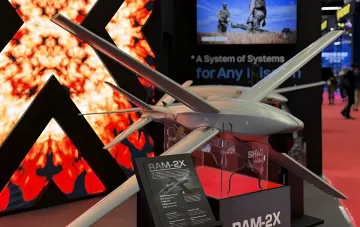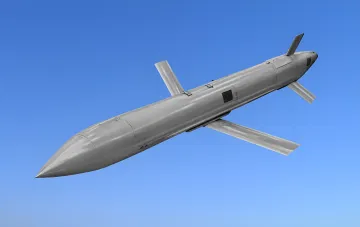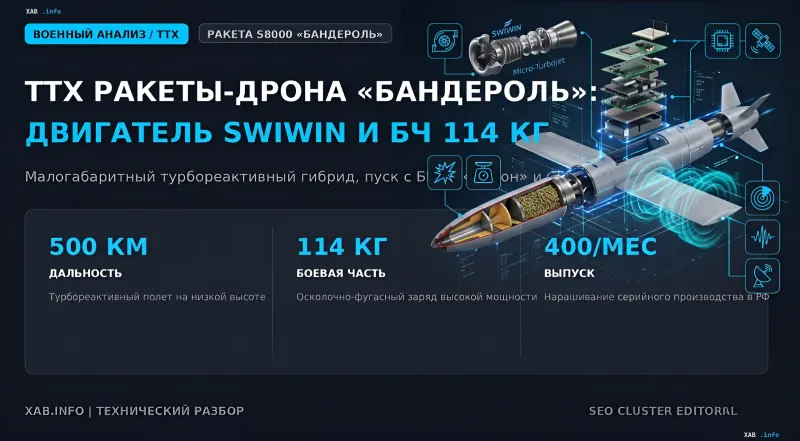
The S8000 "Banderol" munition, developed by specialists at the Kronstadt group, is a hybrid construction combining elements of a compact cruise missile and a reactive loitering drone. Unlike heavy cruise missiles such as the Kh-101 or Kalibr, the Banderol is significantly cheaper due to the use of commercial microturbines and a simplified aerodynamic layout. According to data disclosed by Ukrainian intelligence (GUR) and confirmed by a number of Russian and Ukrainian media outlets, the item is positioned as a tool for mass strikes on rear-area targets at minimal cost per unit of munition. The transition to serial production, recorded in late July 2026, indicates that the Banderol has ceased to be an experimental prototype and has entered the standard armament of strike aviation and unmanned formations.
Swiwin SW800 Powerplant and Speed Profile
The key structural element of the item is a compact turbojet engine from the Swiwin line (model SW800), providing a cruise speed of 450–580 km/h in a compact form factor. This speed profile fundamentally distinguishes the Banderol from propeller-driven kamikaze drones such as the Shahed-136, which remain vulnerable to mobile fire teams armed with machine guns. Turbojet thrust allows the munition to maintain stable flight at ultra-low altitudes (30–60 m) without loss of controllability, which is critical for implementing terrain-hugging tactics. The Swiwin engine is likely an adaptation of a commercial microturbine, which explains both the reduction in unit cost and certain thrust-to-weight limitations, compensated for by the simplified aerodynamics.
Warhead and Employment Tactics
The fragmentation/high-explosive warhead weighing 114–150 kg is capable of inflicting severe damage on masonry structures, industrial facilities, and infrastructure. This figure substantially exceeds the destructive potential of light kamikaze drones (typically 10–50 kg of explosives) and brings the Banderol close to the class of short-range tactical cruise missiles. The maximum range of flight is 400–500 km, allowing strikes on targets in the deep rear without manned aircraft having to enter the engagement zone of air defense systems. The primary launch platform is the medium-altitude reconnaissance-strike UAV Orion (Inokhodets), as well as army aviation helicopters Mi-28N and Mi-8. Aerial launch from a UAV allows the missiles to be released hundreds of kilometers from the line of contact, minimizing the risk of losing the carrier.
The Interception Problem: The Radar Horizon Effect
Thanks to satellite navigation and programmable flight along terrain-hugging waypoints, the Banderol flies along river valleys and forested areas of the Polesia region, using natural terrain barriers. This creates a "radar horizon" effect: ground-based air defense radars detect the target only seconds before it approaches the engagement line. A speed of 450–580 km/h at an altitude of 30–60 m makes interception by mobile air defense systems extremely difficult, and for stationary systems with a limited field of view — virtually impossible. Thus, the Banderol exploits a structural gap in air defense architecture that was not accounted for when designing systems oriented toward intercepting ballistic targets or aircraft at medium and high altitudes.
Contradictory Data
A number of terminological and quantitative discrepancies are observed in open sources. First, the classification of the item is not uniform: Russian media (in particular, utro.ru, 31.07.2026) use the term "cruise missile," while Ukrainian intelligence and a number of analytical publications (unian.net, war.obozrevatel.com) define the Banderol as a "missile-drone" or "hybrid munition." This discrepancy reflects a difference in doctrinal understanding: from the Russian Federation's perspective the item is a missile, from Ukraine's perspective — a modified drone with a missile powerplant. Second, the warhead mass is given as a range of 114–150 kg rather than a single value, which may indicate the existence of several warhead modifications or inaccuracy in the initial data. Third, the range of flight varies in sources from 400 to 500 km, which likely depends on the flight profile and the warhead mass of a specific modification. Exact serial production rates are not disclosed in open sources; only the fact of the transition to serial production is confirmed.
Industrial Context and Long-Term Consequences
The transition to serial production of the S8000 Banderol in late July 2026 reflects a broader trend toward the demilitarization of aerodynamic warfare: replacing expensive specialized turbojet engines with commercial microturbines allows the unit cost of the munition to be reduced by an order of magnitude compared to classic cruise missiles. For the defense-industrial complex this means the possibility of mass production while maintaining an acceptable level of destructive potential. For the adversary's air defense systems, this munition creates a structural load: the number of low-altitude targets moving at speeds inaccessible to anti-aircraft machine guns but too small for effective interception by surface-to-air missiles exceeds the calculated capabilities of existing systems. In the medium term, the emergence of specialized countermeasures is expected — either in the form of low-level radars with increased coverage density, or in the form of short-range kinetic interceptors.