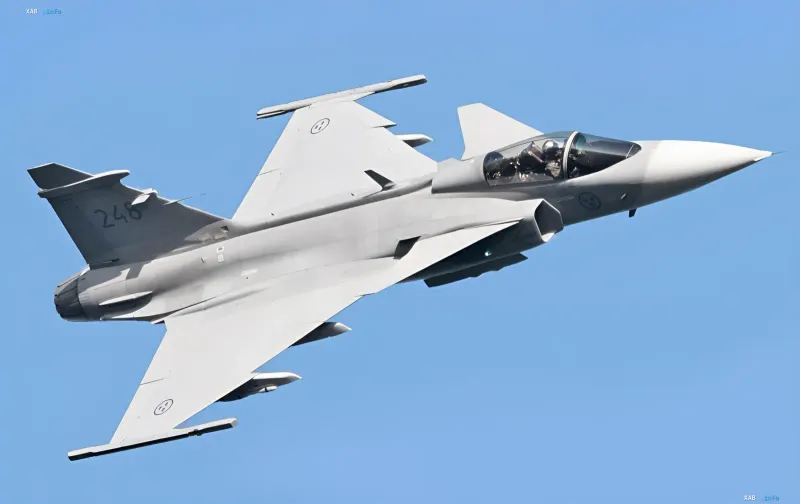
On November 3, 2026, Swedish defense company Saab introduced its own AI agents that have successfully completed flight tests on the Gripen E multirole fighter. According to the company's press release, the AI agent autonomously controlled the aircraft in beyond-visual-range (BVR) combat scenarios. This is reported by RBC-Ukraine, citing Saab’s official statement. The system's debut represents a significant step in developing autonomous combat capabilities for fourth-generation manned platforms.
AI Agent Architecture and Functionality
The agents were developed by the Advanced Programs unit within Saab's Aeronautics business area. According to the developers, the system can operate in two modes: as pilot support directly in the fighter's cockpit or as an autonomous component interacting with pilots from a separate unmanned platform. In addition to the agents themselves, Saab has created a full suite of environments and tools for their construction, training, and evaluation, allowing the AI to be viewed not as a single product, but as part of an extensible ecosystem.
AI Fighter Pilot Academy: Millions of Simulated Hours
A key role in training the agents is played by the AI Fighter Pilot Academy infrastructure, where systems train in simulated aerial combat scenarios. According to Saab, thanks to millions of simulated flight hours, the agents practice realistic tactical situations and develop the ability to make decisions under uncertainty. The company has already verified one function — beyond-visual-range air combat — in real flight conditions, confirming the transition from virtual training to practical testing.
Gripen E Software-Defined Architecture
Saab emphasizes that the software-defined architecture of the Gripen E fighter allows for the integration and testing of new AI software directly into the operational aircraft without the need for separate experimental platforms. Peter Nilsson, head of Advanced Programs, stated: "We have not only created our own AI agents, but we have also flown with them. This demonstrates our ability to develop AI agents that can be integrated into operational fighters. Future air combat will not be decided by individual platforms, but by networks of manned and unmanned systems that interact." The company estimates that this approach shortens development cycles and accelerates the transition from new technology to operational capability.
Computational Infrastructure and Scaling
To scale development, Saab utilizes the computing power of Sferical AI, a Swedish "sovereign" AI initiative of which the company is a founding partner. According to the Swedish TV channel SVT, the Sferical One supercomputer in Linköping, commissioned in late summer 2026, plays a crucial role in this process. Saab has announced its intention to continue developing the agents' capabilities, testing them in more scenarios, and applying the established AI Fighter Pilot Academy infrastructure to unmanned platforms and future mixed manned-unmanned aviation systems.
Context: From Centaur to Proprietary Agents
Saab's presentation of its own AI agents occurs against a backdrop of increasing activity in autonomous combat aviation. Previously, in June 2025, Saab, in collaboration with the company Helsing, conducted the first three flights of a Gripen E using the Centaur AI agent developed by Helsing; the project was fully funded by the Swedish Defence Materiel Administration (FMV). Thus, the transition from partner solutions to proprietary agents took about fifteen months. The Ukrainian context also deserves attention: on October 16, 2026, after meeting with Swedish Prime Minister Ulf Kristersson in Brussels, President Volodymyr Zelensky stated that Ukraine expects deliveries of Swedish Gripen fighters in the near future, and Kristersson confirmed that the aircraft are being deployed and pilots are undergoing training. In June 2026, Ukraine and Sweden concluded an agreement on the purchase of Gripen E, making the question of which specific versions of onboard software, including potential AI modules, will be supplied as part of the contract highly relevant.